Some time ago, I reviewed Yoshihiro Mori’s Netflix film, We Couldn’t Become Adults (2021), and commented on its lack of control and rudimentary composition. More than a year later, and I think I’ve gotten a renewed perspective on exactly where the film went wrong, with the help of another Japanese Netflix special, Yuri Kanchiku’s nine-episode series, First Love (2022).
First things first: while their Korean counterparts have perfected the thriller, the Japanese are masters of nostalgia. My wife and I kept bringing this up while binging through the whole series. You can always rely on Japanese directors (or at least the best of them) to know precisely when to cut in a biting flashback. Yuri Kanchiku nearly does it to a fault in First Love: the entire series is structured as a series of back-and-forths between the past, when its main characters meet and kindle a failed relationship, and the present, with each living broken lives, until fate and circumstance conspire to bring them together. I think what saves the series from ultimately getting boggled down by its nostalgia, the way Adults did, was just the perfect mix of arthouse sensibilities.
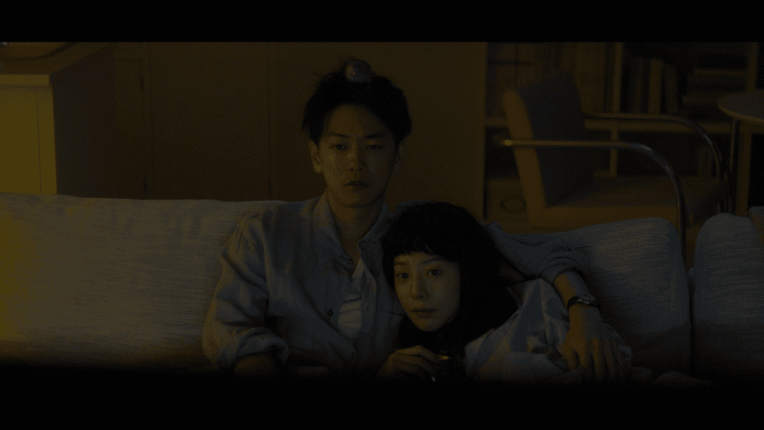
First Love stars the phenomenal Takeru Satoh (who was also in my recent eiga sai favorite, In The Wake) and Hikari Mitsushima as childhood lovers Namiki Harumichi and Noguchi Yae, respectively. When the first episode begins, we first meet them as adults: with Namiki working as a security guard and in (what appears to be) a fairly dry engagement, and Noguchi as a taxi driver and divorcee. At this time, they are no longer in contact, and appear to be perfect strangers, until the narrative clues us in that once upon a time, when both were in high school, they were actually deeply in love. Acting as a side plot, we also meet Noguchi’s son, Tsuzuru (played by Towa Araki), who’s trying to get the attention of dancer and instagram influencer Uta (Aoi Yamada).

It has all the Japanese staples: nostalgia for a past long gone, characters longing for something unknown the feel they’ve lost, and tons of missed connections. Even in the present, fate appears to continue getting our couple just within arm’s reach of each other, even when neither of them realize it. In the opening sequence, Namiki just barely gets inside of Noguchi’s taxi, choosing instead to make way for a pregnant lady. Namiki takes another taxi, but as they by each other at a roundabout, he instantly recognizes her and gains a renewed passion to find and reconnect with her.
Creating an entire series based entirely on a song (or in this case, two songs: the behemoth of a pop culture classic, First Love, and its follow-up Hatsukoi by Utada Hikaru) is so gimmicky it shouldn’t work, but the director’s artistic sensibility is just mature enough to not turn every episode into a music video and free advertising for a decades-old song, though I can imagine Utada would be getting large sums in royalties thanks to this. Instead, the song serves as an effective plot device: in one flashback, we learn that Noguchi is a big Utada fan and buys the CD when it comes out in April 1999. Thereafter the song becomes the theme of their blooming relationship. Her 2007 hit, Hatsukoi (which also means ‘first love’ in Japanese), takes the hopeful and promising tone of the older song and transforms it into the deep longing of separated lovers. The fire kindling between them once more is now aged and weather-beaten, uncertain where it was once optimistic.
Another prize-winning element of the story is the assortment of air travel and space metaphors peppered throughout the series. After all, young Noguchi dreams of becoming a flight attendant, and Namiki eventually serves as a pilot in Japan’s Self-Defense Forces (SDF). Its fourth episode is titled “Space Oddity” and has its narrative structured around the Nozomi project of the Japan space program JAXA. Launched in July 1998, the Nozomi was meant to enter into Mars orbit. However, by December, the Nozomi fails to accomplish its mission, just as Namiki and Noguchi accept that their relationship has missed the mark. In the succeeding years, the Nozomi, along with the souls of our Noguchi and Namiki, will remain drifting aimlessly in space. But Mars will conspire to bring them together yet: in the present day an observatory at the local park opens to let visitors gaze on as the red planet comes closer than it’s ever been to Earth, and who else bumps into each other at the park for this event than Noguchi and Namiki? The shots in this episode are accompanied by the breathtaking transitions involving planets and the solar system, meant to invoke the cosmic movements at play in their lives.
Overall, the series is an enjoyable ride. It’s tender and wears its heart on its sleeve, but thankfully it’s arthouse sensibilities and artistic restraint keep it from circling down some saccharine romcom drain. With a phenomenal soundtrack and a breathtaking shots of the snowy wonderlands of Hokkaido, Yuri Kanchiku has gotten herself a JDrama masterpiece.
Stray Thoughts
- It’s typical for dramas involving secondary love interests to give them with some fundamental flaw or source or incompatibility, to rationalize why they aren’t quite a perfect match as the main leads. First Love does this somewhat with Noguchi’s husband, who is revealed to be a cheating douchebag with a mother who’s snobbish towards Noguchi. For some reason they decided against it with Tsunemi (Kaho Indo), who is probably the kindest, most innocent character in the series. She’s portrayed as a talented but somewhat naive psychiatrist assigned to Namiki’s case after a near-fatal crash while stationed in Iraq. All this makes Namiki’s inevitable break with Tsunemi all the more painful. That being said, the series did a good job making me fall in love with Kaho Indo, and this for sure will not be the last I’ll see of her.
- I had a feeling very early on that I’d seen Mitsushima Haruki elsewhere before this, and I was delighted to find out that she also played the patricidal child delinquent Yōko in Sion Siono’s rowdy Love Exposure (2008). Mitsushima has grown into quite an elegant and beautiful woman, it’s almost impossible to imagine reenacting all the crazy and perverted shit Yōko does in Exposure. Namiki better watch out: Noguchi has an unspoken past to her.
- I still cannot totally ride with Takeru Satoh’s anime-inspired overacting. Part of me still expects him at some point to break out into Rurouni Kenshin rage whenever Namiki so much as expresses his distaste at something. He’s a great actor for sure, but sometimes his characters need to chill out.
 Dominic Dayta
Leave a comment