There is something special about the city at night. All that is bright and shiny under the proud rays of the sun suddenly takes on an eerie patina after dark. When the neon lights take over, the city bares its sharp teeth at the sketchy figures that continue to roam in its smoky corridors. City dwellers understand this and, if they are wise, avoid the city at these hours at all costs. Even in the so-called “first world,” you can never tell exactly what lurks in these dark corners.
This general sense of unease permeates every frame of Makoto Wada’s surreal 1999 chase movie, Round About Midnight (1999). The movie stars then-thirty-nine Hiroyuki Sanada (now of Shogun fame, but who also makes an appearance the Elder in Bullet Train, 2022) as famous jazz trumpet player Koji Moriyama, and Michelle Reis (who may be familiar to some readers as the lovestruck agent in Wong Kar-wai’s Fallen Angels, 1995) as a club worker who must seek justice for the murder of her boyfriend.
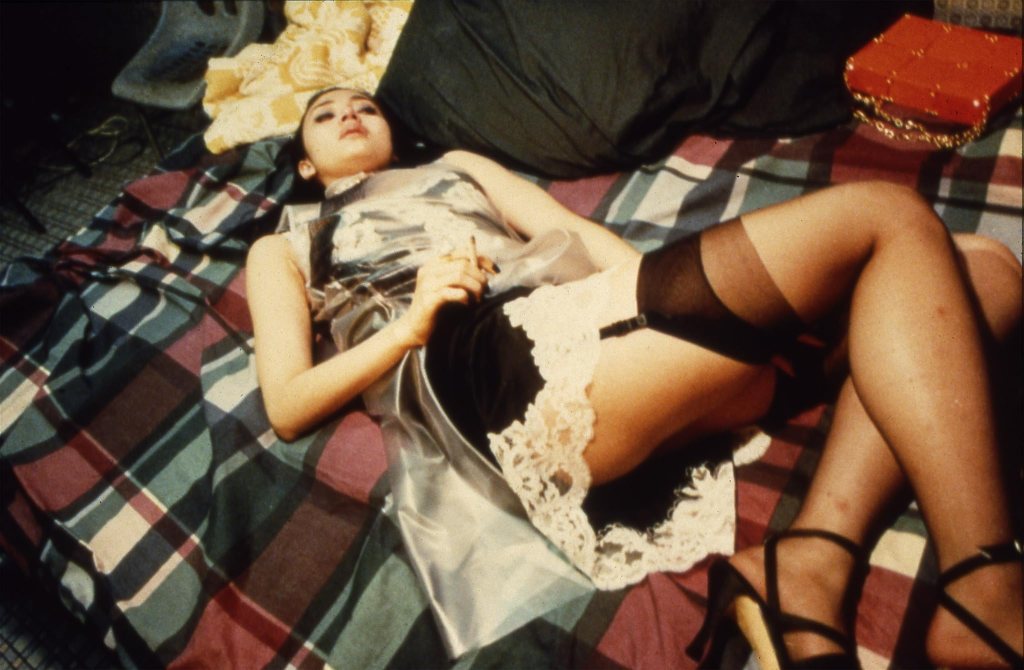
Round About Midnight captures the viewer’s attention right off the bat with a rather playful approach for introducing its dramatis personae. On a late night in Yokohama, we witness four shadowy figures emerge two-each from two cars in a dark multilevel parking lot. Without exchanging a word, they carry out what we understand to be a surreptitious transaction. Afterwards, two of the men exit the scene while the remaining two — clad in two-piece suits — watch them drive away. Just as they are about to leave, a fifth man, himself dressed in business formal albeit shabbily, emerges from behind one of the parked cars to confront them. We hear nothing of this conversation, but we understand that the newcomer may be in danger.
Before the meeting can progress, however, the camera pulls away and pans over the city, awash in the dappled glow of the neon lights on asphalt roads made wet by a recent rain, into the window of a smoky jazz club just as Sanada as Koji is performing with his quintet. During a break (Koji informs the audience that they will continue the set at midnight) we learn from a brief conversation between Koji that this may just be his biggest night yet. A famous American jazz musician who goes by the name G.P. is stopping by for his midnight set, and if Koji can impress him, he just might get a chance to take his talent abroad. While Koji dismisses this possibility, the look on his face betrays his interest. He excuses himself, wanting to work on the rest of their pieces by himself on the club’s rooftop. He promises to return before midnight.
We return to the scene at the parking lot. The two men, we find out, are corrupt detectives in cahoots with the owner of some club. They have been using some of the club’s girls — many of whom immigrants with rather questionable residency status — to mule contraband in and out of the country. The man reveals himself as the club owner’s accountant, and he threatens the officers of having collected “crystal clear” evidence of their activities. As the confrontation reaches a boiling point, the camera pulls away once more, this time zooming into a back alley, to a woman (Michelle Reis as Linda) in a red floral dress running by, trying to catch something or someone. We are made to understand that she knows the accountant, that she senses the danger that he has put himself in. But she reaches the parking lot just in time to watch the accountant’s murder. The detectives see her, and a chase ensues.
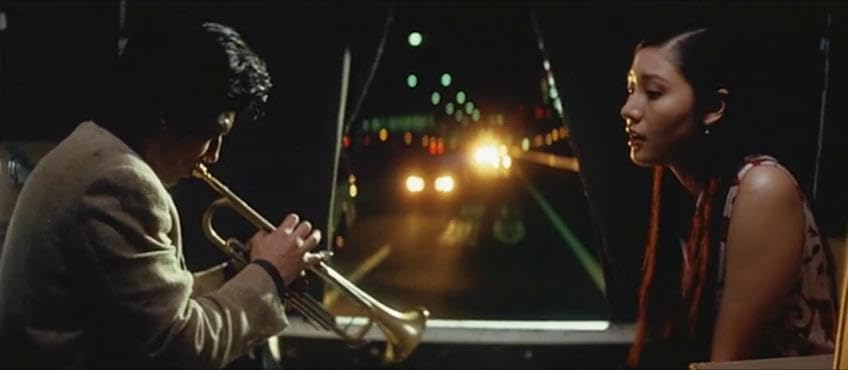
And so our characters’ paths begin to entangle. The detectives eventually corner the woman beneath the fire escape of a familiar rooftop. From the fire escape emerges a confused Koji, on his way back to the jazz club, and he instinctively rescues this strange woman from her captors. Later, as they drive away from the detectives in a stolen red convertible, it finally dawns on Koji the kind of situation he has unknowingly walked into. The detectives and the club owner’s goons have now seen his (rather famous) face. Now he is implicated. He has no choice but to accompany Linda on her mad dash to bring justice to the accountant’s death by finding his alleged evidence — and hopefully still make it to his big performance.
While the above descriptions might make Midnight sound like a grim thriller, it certainly rises to more than just that. Wada skillfully plays around with the tropes of the genre, all the time refusing to be predictable, with irreverent improvisations that make the movie actually feel like jazz. Chase scenes are accompanied by delicious drum licks. Hilariously, so much of the cat-and-mouse sequences could have been easily abridged by either the detectives or the goons had they just made use of their guns. Yet either they forget to do so or Koji, when cornered, makes a last-minute wisecrack that dissuades them from actually pulling the trigger. And — get this, the night is saved thanks to music. No spoilers. We’ll leave it at that. The movie is thrilling without taking itself too seriously, hilarious without breaking pace.
The actors themselves appear to be in on this improvisation. There is the absurd way that Sanada holds on to Koji’s trumpet through every single scene like he’s toting some kind of potent weapon. When backed into a corner, he convinces himself into jumping from ledges or into garbage chutes by screaming out the title to one of his quintet’s pieces, “So What?!” Meanwhile, Reis pretty much appears to have fun playing Linda, an undocumented immigrant of unspecified origin, delivering every line of dialogue with an exaggerated gaijin-generic accent — something one of the side characters even apes during a pivotal moment to wry comedic relief.
Round About Midnight is less a chase thriller and more of a surreal encapsulation of the strange possibilities hiding in the dark corners of the city. Watching it gave me a similar can’t-look-away thrill as reading Haruki Murakami’s After Dark, which I guess is further proof that this curious unease with the city at night just might be something universal. Loiter around these streets at night, and you just might find yourself in running for your life. Round about midnight, anything is possible.
Stray Observations:
- Though apparently forgotten except by some diehard fans of Japanese cinema, this movie sits right at home with other notable films of its era. It was released on the same year as Lee Chang-dong’s Peppermint Candy, just four years after Fallen Angels.
- Just as in Fallen Angels, Michelle Reis continues to be a stunner. But then again, we are talking about an actress who has made her mark in film history playing the femme fatale.
- Another heavy hitter featured in the film is Jun Kunimura, who plays the role of Boss Tanaka in Quentin Tarantino’s Kill Bill Volume 1 (2003) and Volume 2 (2004), Yoshikawa in Takashi Miike’s Audition (1999) based on the novel by Ryu Murakami, and the creepy old man in Na Hong-jin’s The Wailing (2016).
 Dominic Dayta
Leave a comment