I had always been curious of going to a World Expo. Mentions of such large fairs – supposedly something of a cross between a theme park and a museum – peppered my early life and education. While I’m not exactly the type of person who pays admission fees to theme parks so I could ooh and aah at large displays, this concept in particular piqued my interest. What transpires in there? When the world’s countries get together to showcase their combined vision of the world as it is today and where it is headed, what does it look like?
The Osaka World Exposition 2025, or Expo 2025, commences today and will continue until October 13 in Yumeshima (“dream island” in Japanese), a man-made island in Osaka Bay built specifically for this six-month event. My fellow students and I at the university were actually faraway witnesses to developments in the Expo when we noticed that the signages along the stations of our nearby Kintetsu-Chuo line being replaced, changing Cosmoquare as the previous terminal station, to Yumeshima. Apparently this is the second time that Osaka is hosting a World Expo, with the last one being in 1970.
Grandeur
I was able to secure a ticket for a test run through a network of international students and scholars in Japan. The ticket granted me free access to the fairgrounds and experience the Expo for one day (April 5). Not all of the exhibits were open then: mostly it was the Japanese exhibits (referred to as “pavilions”, as they were entire buildings in themselves) plus not a few foreign countries, but that was enough of a taste for me, as my abhorrence for large crowds means I’m unlikely to consider returning on my own dime once everything is up and running.
In Chapter 5 of F. Scott Fitzgerald’s The Great Gatsby, we see Nick Carraway coming home from a dinner in which he has finally learned of why Gatsby has purchased a house at the opposite coast to where Nick’s cousin Daisy Buchanan lives, and why he has been throwing his lavish parties. Carraway lives in a small cottage next to Gatsby’s grand mansion, and on that evening the entire place is lit all over.
At first I thought it was another party, a wild rout that had resolved itself into “hide-and-go-seek” or “sardines-in-the-box” with all the house thrown open to the game. But there wasn’t a sound. Only wind in the trees, which blew the wires and made the lights go off and on again as if the house had winked into the darkness. As my taxi groaned away I saw Gatsby walking toawrd me across his lawn.
“Your place looks like the World’s Fair,” I said.
“Does it?” He turned his eyes toward it absently.
Supposedly, Carraway is referring to the Chicago World’s Fair of 1893, also known as the Columbian Exposition. Electricity (then still an emerging commodity) featured in the Fair as its central vision of the future, later becoming renowned for its bright and dazzling display of electric lights strewn all across Jackson Park in Chicago’s South Side, covering approximately 690 acres. The fair boasted a large water basin supposedly symbolizing Christopher Columbus’s voyage, and the original Ferris Wheel, standing at over 264 feet and capable of carrying over 2,000 passengers at a time.
To people walking amid the large beaux-arts architecture built specifically for the exposition, along streets peppered with statues and brightly-lit electric posts, it must have truly felt like they were being granted an experience of the next millenium. The size and grandeur of its vision would cement the 1893 Fair in the American psyche. In Thomas Pynchon’s thousand-page tome Against The Day, the Fair serves as the turning point of a new history that would reach its boiling point in the first world war. As for Fitzgerald, the Fair served as a subtle dig at the size of Gatsby’s vision: one man’s dream so large, it encapsulates the world.
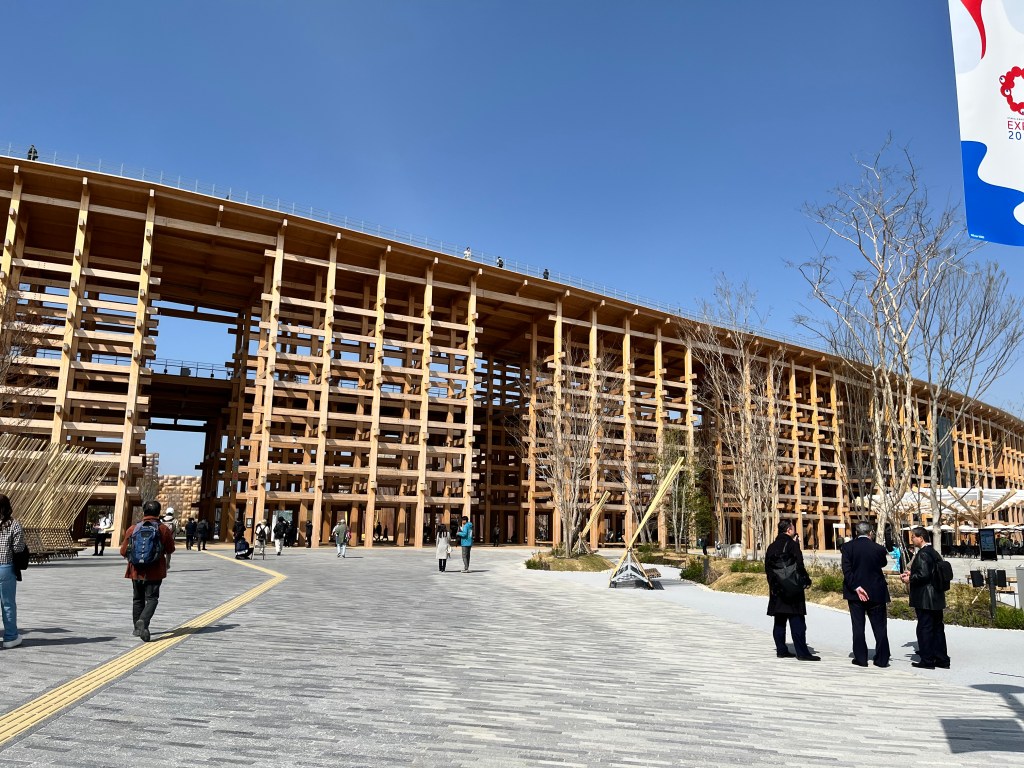
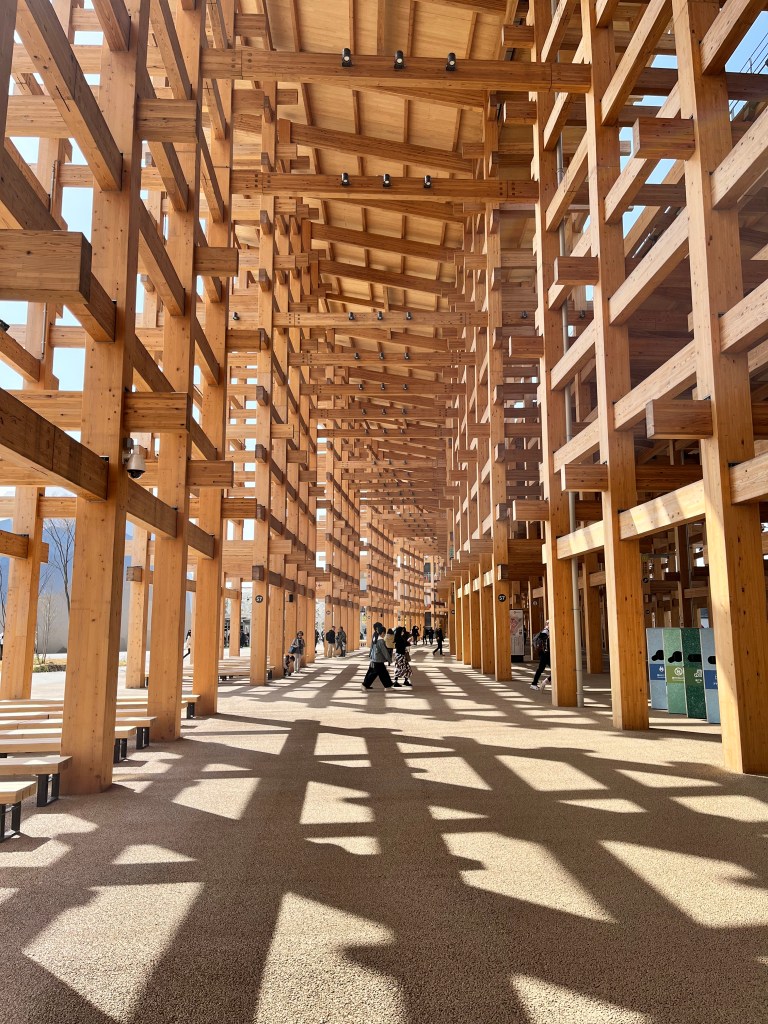
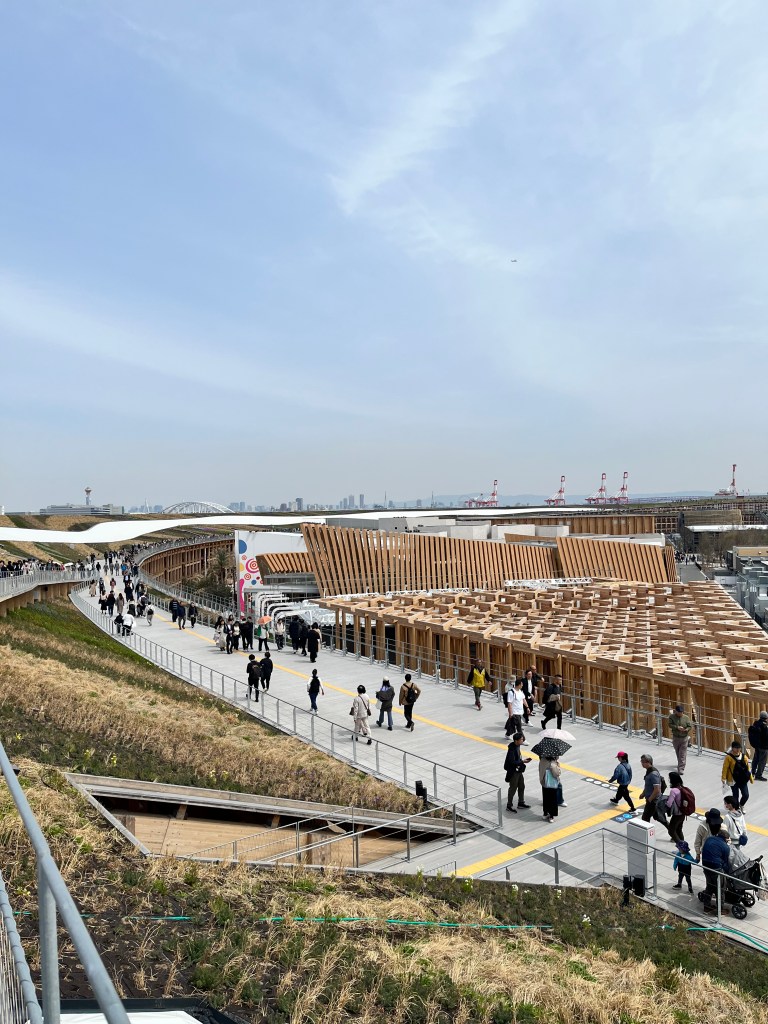
Expo 2025 continues on this legacy of grandeur. Upon entering through the main gates of the fairgrounds, one is greeted by the sight of the Grand Ring, its central architectural feature. Designed by renowned architect Sou Fujimoto, the Grand Ring is a testament to the quality of Japanese woodwork and engineering. It’s a massive circular wooden canopy spanning approximately 2 kilometers in circumference, with a height of up to 22 meters, and covering 60,000 square meters in area.
The design brings to mind traditional Japanese carpentry, of the kind that can be found in temples like the Kiyomizu-dera, using an open, lattice-like framework to maximize natural light. The openness also takes advantage of the breezy wind conditions near the Osaka Port Area. As a metaphor for the Expo’s vision, it’s right on the mark, as the Grand Ring demonstrates an impressive marriage of tradition and modernity, without sacrificing environmental consciousness.
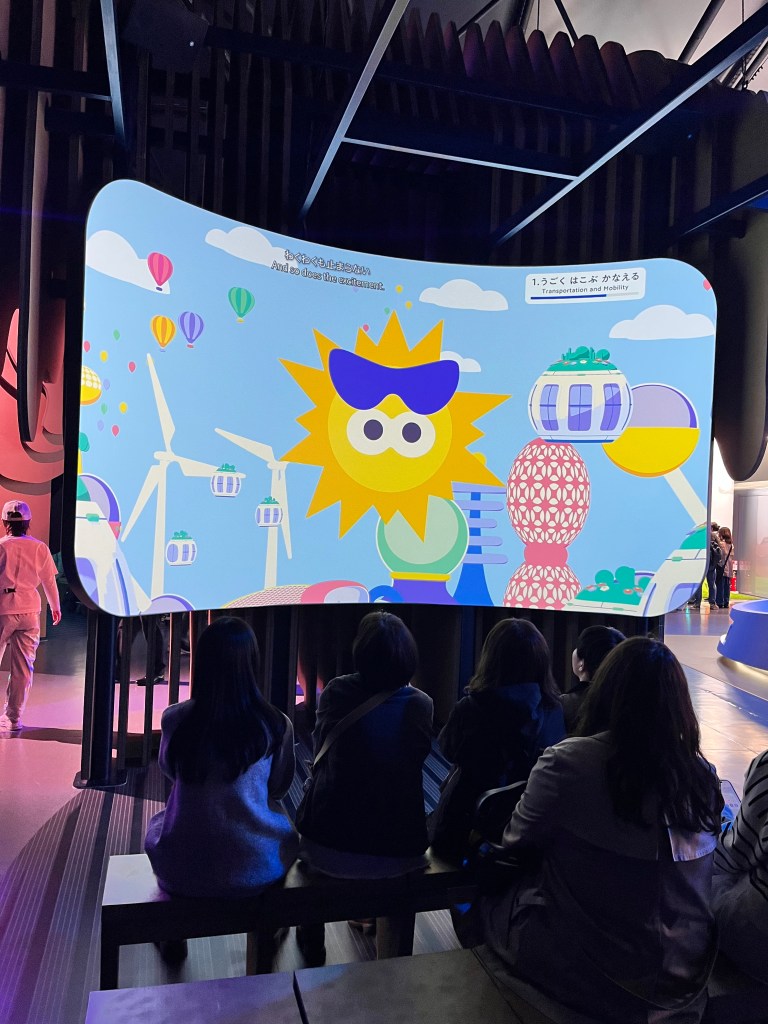
Inside the Grand Ring itself, however, the future is just as sleek and shiny as any science fiction movie. There’s also a borderline horrifying number of screens. Inside a Future City exhibit led by top Japanese conglomerates like Hitachi, KDDI, and Kawasaki, one is assailed by multitudes of LED displays showing their vision of how artificial intelligence, for example, could make smart home systems that dynamically manage energy consumption to maintain efficiency while keeping the interior spaces comfortable (but what’s powering the AI?), and how drones can deliver personal packages straight to our doors so delivery trucks won’t congest our roads (imagine the nightmare of thousands of Amazon Prime drones buzzing over our heads every day).
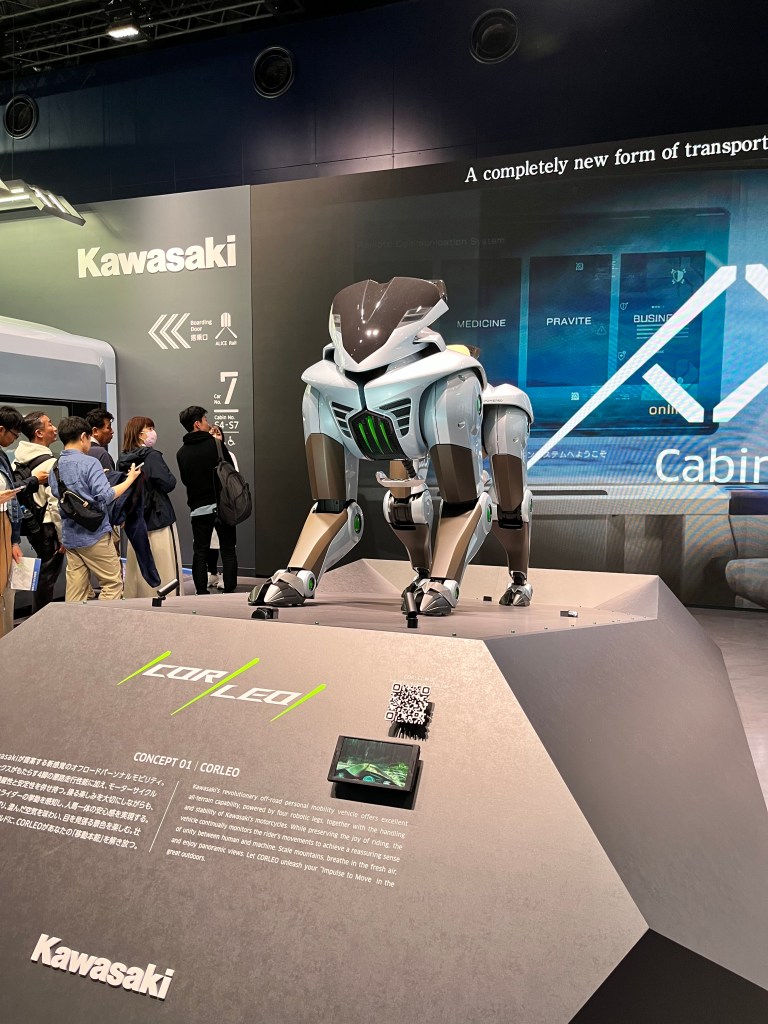
I hate to seem like such a downer towards the hardwork that the employees of these companies have put into making a genuine gesture towards the future. There were also not a few exhibits that I found interesting, like an off-roading vehicle being developed by Kawasaki that you can ride horseback (but what’s wrong with wheels?), and a KAUST project at the Saudi Arabia pavilion that uses 3D printing to catalyze rebuilding of coral reefs.
But all these simply strengthen a feeling that I’ve been having of late regarding the global technology industry: in imagining the future of technology, we seem to be severely limited by the technology we already have. Have we innovated enough, at least for the meantime? Perhaps it really is time to stop focusing too much on new technology we don’t have, and use existing technology to solve problems we have too much of.
Vision Problems
Prime Minister Shigeru Ishiba has expressed his hope that the Expo would foster global unity amid ongoing international divisions. Indeed, the world appears to be in a process of undoing the Post World War II status quo, and whatever new order arises seems entrenched in uncertainty as the world bears witness to two major ongoing theaters of war. I think it’s a miracle that an Expo could even be pulled off at the moment.
Not all World Expositions leave a positive image to posterity. My history classes at University brought to my attention the horrific 1904 St. Louis World’s Fair, known also as the Louisiana Purchase Exposition. Held in St. Louis, Missouri from April 30 to December 1, the fair was supposed to commemorate the centennial of the 1803 Louisiana Purchase.
The fairgrounds spanned 1,200 acres, comprising more than a thousand buildings and attracting millions of visitors from all over the world. But in the midst of its grandeur, the organizers thought it fitting to showcase a “human zoo” containing various indigenous peoples of colonized regions, among them the Philippines and Africa. The human zoo was meant to contrast the modern “new world”, with its gifts of science and technology, and the darkness that still pervaded what they perceived as their primitive lessers.
It gets worse: in conjunction with the 1904 Summer Olympics, the captured indigenous individuals were made to participate in competitions against white athletes, supposedly to highlight their inferior biology. While the 1893 Chicago World’s Fair cemented a legacy of futuristic innovation, the Louisiana Purchase Exposition created one out of pseudoscience and white supremacy, a stain on history that’s refused to be erased, and is only growing bloodier and bigger still, with the rise of fascism in the west.
We have certainly come a long way from those horrific years. The Philippines is now a participant rather than a captive in a human zoo at the Expo 2025. While the Philippine pavilion wasn’t finished yet on the day of the test run, I was able to see its proud exterior showcasing our proud tradition of textile work. African countries like Kenya and Uganda are also present, showcasing their work towards improving food security and healthcare in the region.
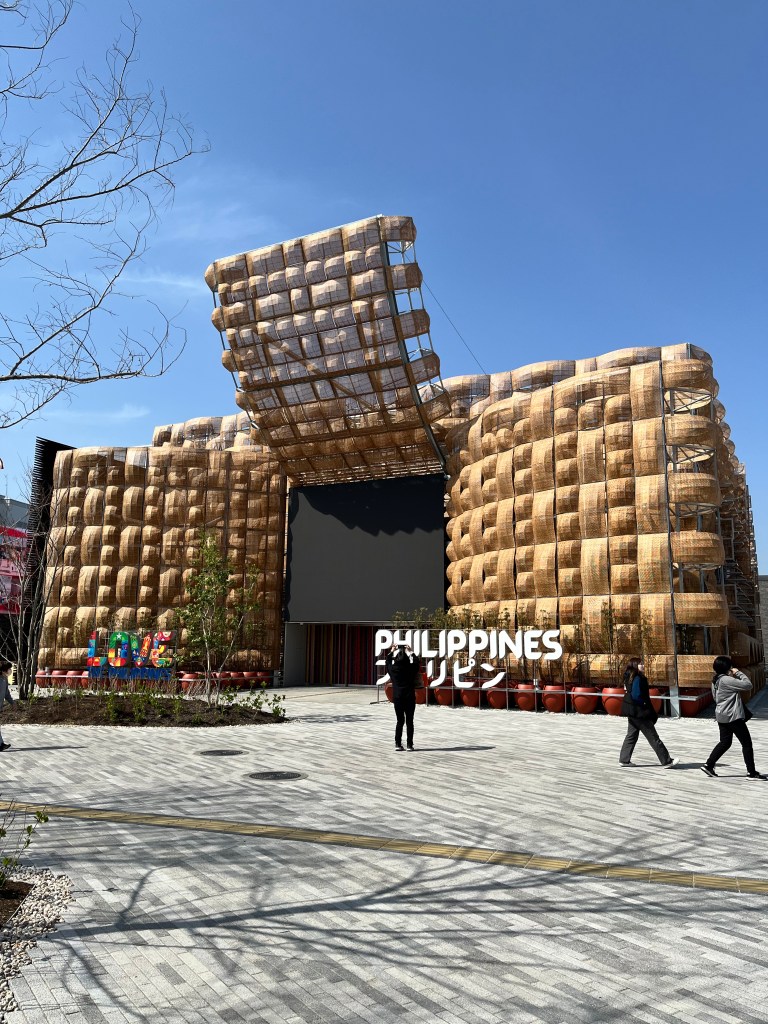
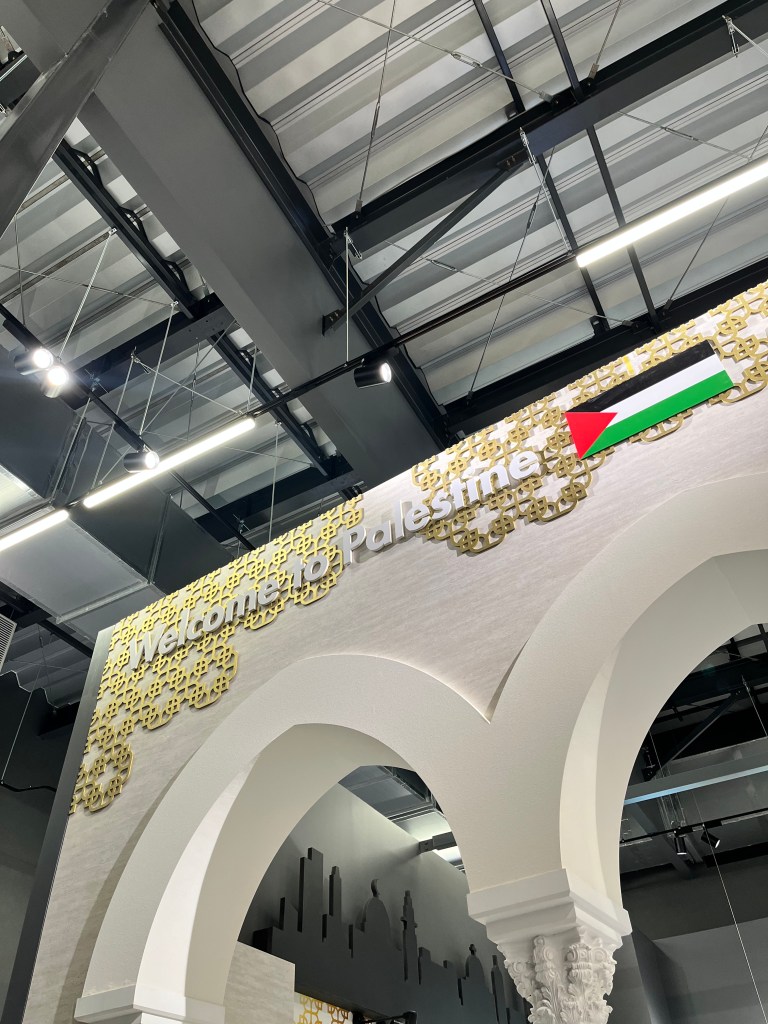
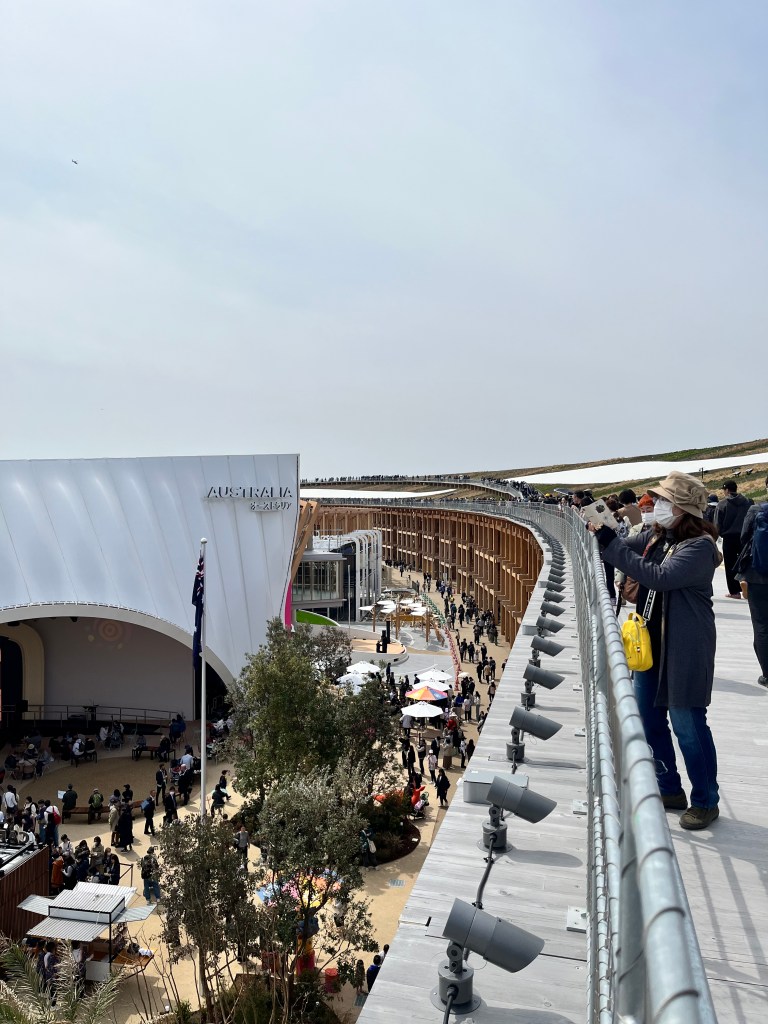
But the Expo is not without its tensions. I noticed that Palestine did not have its own pavilion like the other countries, and was instead constrained into a small corner of a shared (or “Commons” pavilion). The corner itself seemed unusually empty, with only a few wall-hung photos that made the already cramped space even emptier. I overheard a conversation with two people at the booth wearing official Expo badges that their shipment of several exhibit items were being held by Israeli authorities. Whereas Israel has its own pavilion, planned to feature a stone from ancient Jerusalem, something that has already sparked heated debates, with Japan caught in the middle.
The World Expo is supposedly a “cultural theme park”, meant to showcase to visitors the many wonders of the world. But on my one day visit, I couldn’t shake off the feeling that the wonders that I was seeing followed a tightly controlled narrative. The organizers are taking what they perceive as the safe route, avoiding the often contentious politics and opposing narratives that come with global intersectionality.
There is also the profit aspect of it all. Of course, an event like the Expo 2025 requires money – lots of it. All things considered, the Expo felt more like a mall, not just because of the many shopping venues and overpriced food stalls (I paid 1,800 yen for a pint of beer!), but because of the looming and un avoidable omnipresence of brands. Over here is an “Earth Market” showcasing the wonders of nature, brought to you by 7 Eleven. Over there is a pavilion celebrating women, in collaboration with Cartier. Is this really our vision of the future? High rises, LED screens, and brand sponsorships?
The Future Is A… Casino?
Before the pavilions, and before the grand ring itself, what immediately caught my attention on my arrival for the test run was the sheer size of Yumeshima station when I got off the train. Aside from the island, they also had to build an entirely new station on the Kintetsu-Chuo line, past its original terminus at Cosmosquare. At least Cosmosquare catered to a few government offices (I’ve been there a couple of times for visa matters), but there’s absolutely nothing on Yumeshima aside from the Expo. To accommodate the swelling crowds expected to arrive from all over the world, the station and island were built to scale. And after my original awe had passed, I was left wondering, as I’m sure not a few locals also were, what happens here after the Expo?
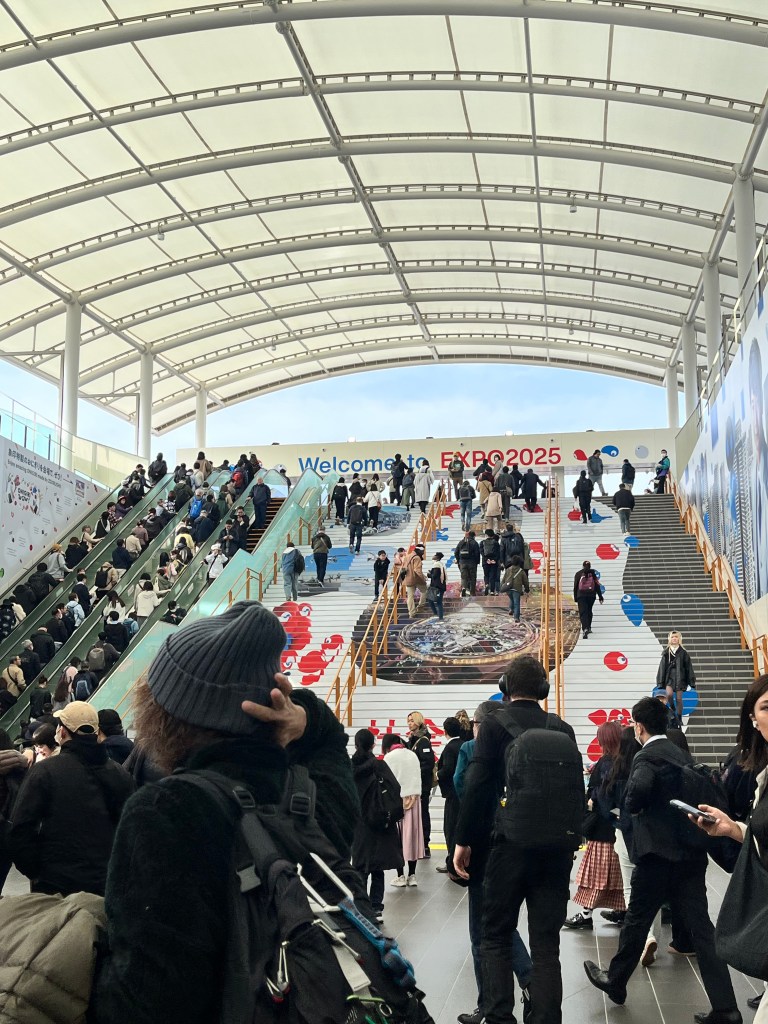
Originally, the area around Yumeshima was used for industrial waste disposal. Transforming it into the Expo fairgrounds initially raised concerns about methane gas emissions that had built up in the landfill underneath, which on deeper consideration makes for quite the apt metaphor. But poisonous and potentially explosive gases aside, there’s simply nothing else to do in Yumeshima once the Expo has finished, and the pavilions taken down. The industrial waste is because Yumeshima is situated around factories and chemical plants. The question remains, what’s next?
Plans are underway to transform Yumeshima into an entertainment hub, something like the Mall of Asia/Solaire area in Parañaque, Metro Manila. The area is planned to be the home of Japan’s first integrated resort and casino, which proponents argue will boost tourism and stimulate the local economy. Criticisms have been raised, however, concerning the social implications of turning the Expo site into a gambling paradise, and plans to dismantle the “Grand Ring” after so much hullaballoo about its environmental friendliness reeks of the same wasteful attitude that is quickly killing the planet.
It will be dishonest for me to say that I was disappointed with my free visit at the Expo. The short of it is that I had fun. I spent the day filling up craft beers and sausages while going to every open pavilion in sight (visitors should be aware that pavilions must be reserved before their visit). But of course, once the pavilions close up, and the last drop of alcohol in my system had been sweated away (I walked more than 20,000 steps on that day), one must naturally ask the question of what vision of the future is being sold to us, and what legacy do these six months leave to the history books? My one-day dream at Yumeshima had the subtle reek of nightmare, sponsored by…
 Dominic Dayta
Leave a comment