I’ve probably done more gaming over the last two years than in the rest of my life combined, and more so in the previous month since purchasing my Switch. I couldn’t have chosen a better time either, as I’ve right now more or less completed my requirements for the PhD and have only to apply finishing touches to the running draft of my dissertation ahead of the December deadline.
This is something that I actually discovered way back last year, when my wife and I picked up Borderlands 2 and ended up playing co-op for hours on end. Before then, I had no idea video games could be fertile ground for intriguing narratives. Even when I first purchased Borderlands 2 as a fun little aside when I got my Macbook three years ago, the story part all but whooshed over my head, and I guess that explains why I never got very far into the game, eventually abandoning it until Monica finally taught me the mechanics.
See, before that, my idea of video games was Counter Strike, DoTA 2, and Valorant. I remember one time my cousins, who were very big on Counter Strike invited me to play along with them, and I pretty much just spent that time dead and in spectator mode, watching my cousins take on members of the opposing team with admirable skill. Suffice it to say they never invited me again. Even now, my younger sister bugs me at least every other week to join her on Valorant, and while I’m certainly the type of person who’ll get into a new hobby for the sake of bonding with friends and family (to wit, my sisters got me into K-Pop in the first place) – I just can’t. Or rather, won’t.
Don’t get me wrong: I’m not trying to shit on battleground and MMORPG players. My closest friend from college is really big into e-sports and League of Legends, and it’s always amazing to me how people like him (and my cousins, and my younger sister) can compete in arenas against players from all over the world. It requires so much dexterity, fast reflexes, strong mental and physical coordination, and in my opinion deserves very much the title of “sports”, but I was never really the sporty or competitive type, y’know? I may (very, very, very rarely) dribble a basketball and shoot a few hoops with a few friends who will take it easy on me but will I ever join even a minor league? Probably not in this life at least.
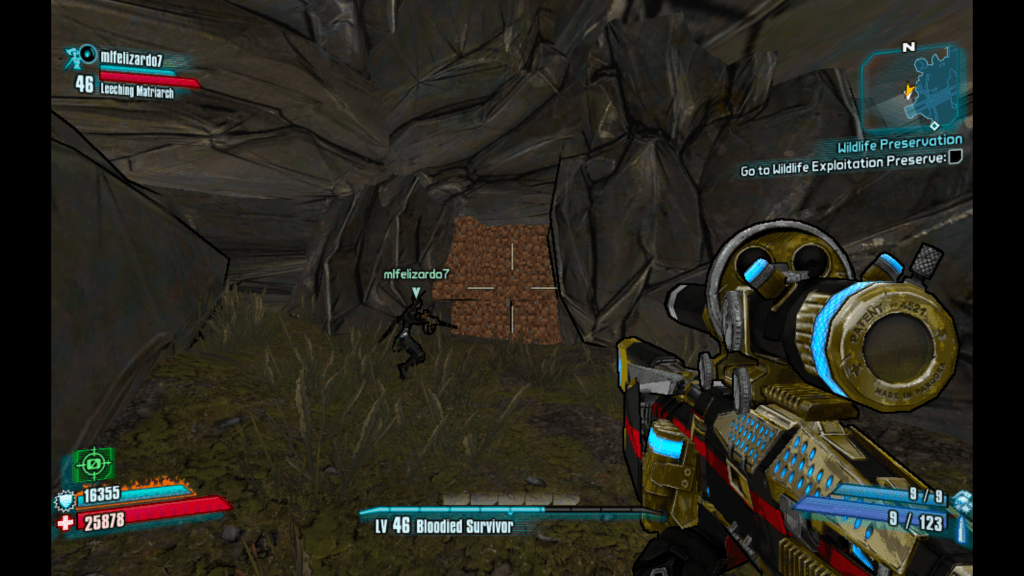
But Borderlands 2 – and recently I also finished the first BioShock – is nestled within the same first person shooter category as Counter Strike or Valorant, so what’s the difference? For me it’s a big thing: story. I’m a real sucker for stories. All my hobbies center around immersing myself within some kind of narrative, be it in the movies, between the pages of a book, or even writing this blog. The shooting can be ecstatic, but after a while it does get old. I can always get more ammo, but my attention span and available free time are very limited quantities. If I wanted to spend half my time spectating better players, I’ll just pull up Twitch (which I also rarely do because who the hell has that kind of time?).
In Borderlands 2, you play as a vault hunter tasked with helping a dissident militia called the Crimson Raiders bring down an evil corporation trying to take over their planet. It doesn’t help that the planet is a Mad Max style post-apocalypse full of petit warlords and their army of suicidal bandits, so you’ll have to shoot your way through to the corporation’s well-defended fortress. The enemies don’t just get bigger and stronger: along the way you discover the history of the world, and the character you’re inhabiting. You learn the stakes of your mission. And dying and being a noob is perfectly okay because you’ll just respawn at the last checkpoint (obviously this is very important for me).
Another thing I love about these games is that they end. A completionist playthrough of Borderlands 2 with all the downloadable content can take upwards of a hundred hours, but it still has that discrete ending. The story eventually reaches a (hopefully satisfying) conclusion that makes all the effort of grinding raid bosses, looting ammo and in-game money, and driving around maps teeming with mobs all worth it. Handsome Jack, the charismatic CEO of the Hyperion corporation, is eventually killed and his colonialist plans foiled. By contrast, a Valorant map is just that: to me it just feels like different avatars scurrying around the same set of places, over and over again, like beings cursed in some purgatorial loop.
Through my Switch, I also recently discovered the wonders of the Visual Novel (also called Kinetic Novels, or Novel Game) genre. This specifically through Doki Doki Literature Club Plus!, which I purchased secondhand via Amazon. Up to that point, I had heard only very little about Doki, mostly about how it starts as your standard issue anime dating simulator only to then gradually progress into something not that. Exactly what was in store, I had no idea, and I was pleasantly surprised when the game started pulling down the facades.
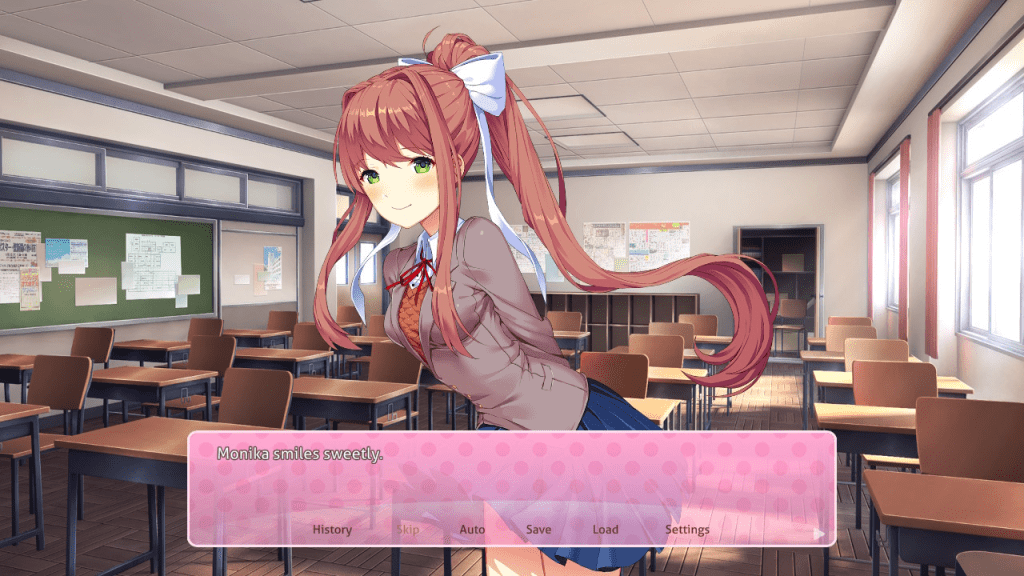
In Doki, you play as the male main character who’s been invited by his childhood friend and archetypal genki girl Sayori to join her literature club after school. You join, and in the club meet the other three members: the class president and honor student Monika, manga and pastry loving tsundere Natsuki, and the timid and shy yandere Yuri. It’s deceptively designed to look, feel, and even sound like a regular anime dating game, but as the characters begin to grow out of their stereotypes, the game itself starts to take on an uncanny connection with reality.
While I enjoy the catharsis of watching the story unfold after a battle or two, there’s also something fun about not having my strengths (or really, weaknesses) as a player be a factor, but still be involved to some degree. And because developers of visual novels are not optimizing for enemy AI tactics, battle mechanics, power-ups or what have you, very often they are able the impacts of player choice more palpable in the gameplay. Doki is probably not the strongest example for this, given that its endings are quite limited, but exactly what scenes play out depend on whose among the girls’ tracks you decide to pursue. The playthrough is also quite short (one run should maybe take 2 to 3 hours), inviting you to replay and try out another track to discover the other scenes.
I laughed when I saw, some time ago, a quote from Sam Altman saying movies will one day become video games, woefully misunderstanding the point of film. While the interactivity of video games has certainly enabled an entirely new way of delivering and interacting with story (in the same way that the movies transformed the written word into something more lifelike), not everything needs to be a video game. There’s a point when you just want to sit back and let the author take you into their world. Visual novels are an interesting synthesis of this. While some titles in the genre certainly introduce elements from more traditional games like tactical RPGs and point-and-click puzzles, it’s still mostly about the narrative.


Leave a Reply