Mieko Kawakami’s 2009 novel, Heaven, sometimes reads like a shelved treatment for the Saw franchise: one in which Jigsaw is a bully at a Japanese middle school. Its taut, unassuming prose makes descriptions of adolescent violence hard to stomach when it really gets going, but stomach it you will, because interweaved with its brutality is a sharp observation on a friendship whose main bedrock is terror.
But I’m getting ahead of myself: Heaven is the second book by acclaimed Japanese author Kawakami to be translated into English. We in the anglophone world are grateful to the labor of Sam Bett and David Boyd for giving us access to the effervescent yet gritty landscapes that make up Kawakami’s oeuvre, in a high quality translation via Europa Editions and Picador Books. I read her first novel, Breasts and Eggs, about two years ago, after I came across her interview with Haruki Murakami regarding his fictional treatment of women. In it, she demonstrates the same sharp tongue and quick wit that flavored her interview, in interrogating women’s place in contemporary Japanese society. I knew at once I had a new favorite author on the rise.

Heaven did not disappoint. First published in the original Japanese in 2009, and imported into the UK and beyond in 2021, the novel centers on the life of middle-school boy Eyes, called so by his classmates for having a lazy eye. He suffers daily at the hands of his bullies, led by a smart and handsome kid named Ninomiya and his quiet assistant Momose. When he befriends another bullied kid in class, a girl named Kojima, he finds himself a confidante and a comrade. Through letters and moments spent together at a fire escape staircase at school, they form a bond through their shared terror.
Over the summer break Kojima brings Eyes to one of her favorite places: a museum that features a painting that she has re-titled “Heaven”. In it, a couple can be seen eating together, in a place where nothing can bring them any more pain and suffering. This is the ideal that Kojima strives for: a heaven where the pain of her present life cannot reach her. For her, the suffering she and Eyes endure at the hands of their oppressors is a kind of religious purification. Pain becomes the bedrock of her very identity – and such is true for Eyes, at least in her mind.
While his friendship with Kojima brings him some respite, Eyes struggles with this ideal. Does it really make sense for them to suffer? Is there perhaps a way out of their pain? He just can’t seem to wrap his adolescent mind around a world where right and wrong seem to have so little weight, and people are free to hurt others, or be themselves hurt without accord to any significance or reason. He is desperate to climb out of the rut that is his day-to-day experience, but it’s the same rut that Kojima clings to.
Based on how other people have approached the novel, it appears much of its appeal comes from an unblinking and honest portrayal of bullying. Kawakami does away with the self-preserving bullshit that most (adolescent-targeted) works parade around, of bullies being shaped by their environment, or violence being merely an unfortunate medium of release for the bully’s own suffering. Kawakami’s bullies, Ninomiya and Momose, are unrepentant. They bully not because of an unexamined suffering at home or elsewhere, not because of any slight that was done to them by their victims. They bully because they simply happen to have that kind of mood, and their victims simply happened to be at the wrong place, at the wrong time.
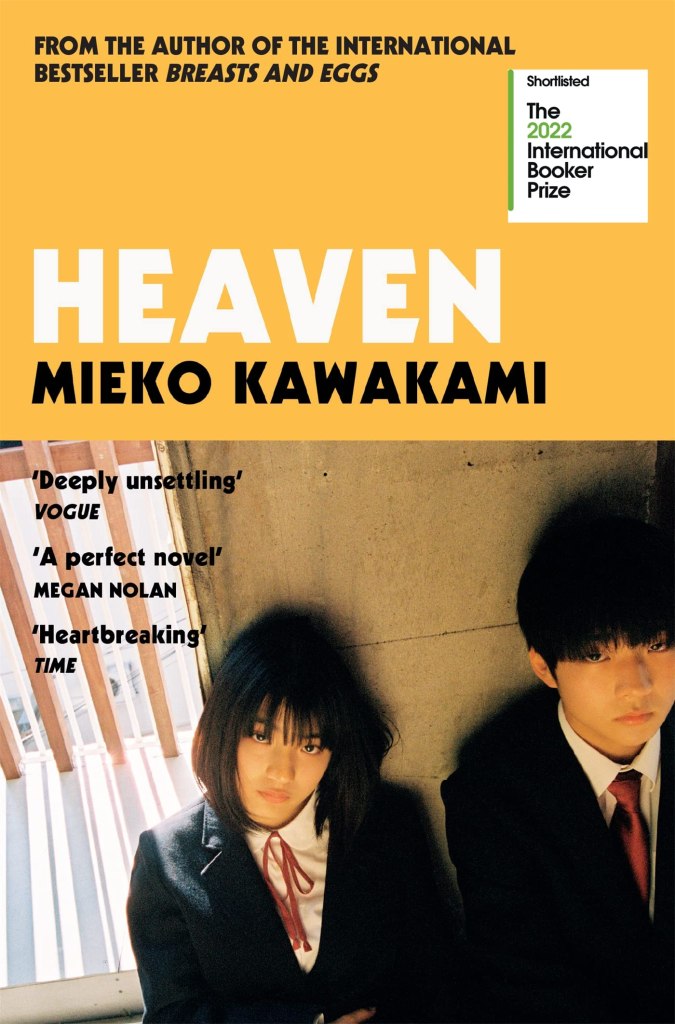
But in reading the book, I couldn’t help but be drawn instead to the lopsided idea of friendship that develops between Eyes and Kojima. It’s a lopsided bond that, I think, speaks to some degree to the kind of society that emerges under violent circumstances, like a long history of colonialism, or a brutal authoritarian regime. We have a term for this back home in the Philippines: “crab mentality”, or a tendency for suffering people to pull each other back into the mud whenever one appears to be making their way out of it. On the Picador paperback I bought off Mercari, the blurb asks us, what is the nature of friendship when its shared bond is terror?
The answer that Kawakami points us to, I think, is a reification of that terror. Through her letters and her eventual dismissal of Eyes’s desire for self progress, she comes to identify herself as the meek saint, the proverbial downtrodden. She believes that her suffering in this world gives her a kind of ticket to her Heaven, and any attempt at rising above that suffering is a rejection of that future Heaven. To suffer is her place in the world, and she has been afforded that place for a reason.
I don’t quite think it’s a perfect novel, like its many glowing reviews have claimed. I think the novel stops short just when its gears really get moving. For one I think it would have made way for a much stronger exploration of the nature of bullying if we could get more out of the likes of Momose and Ninomiya, beyond a short dialogue that occurs between the former and Eyes near the climax. Moreso, Ninomiya’s perspective would have provided a more interesting foil to Eyes’ meekness, as he was the one taking charge in the violence. Momose had always been more of a bystander. Not once in the book did he even land a hit, though he certainly counts among Eyes’ tormentors for sure.
The ending, though a strongly written and heartbreaking scene by itself, feels a little shaky given how little material it stands on. But all this isn’t to say that Kawakami hasn’t delivered on her objectives with the book. Its brevity is certainly used to great effect: the characters stay around only for as long as they are needed, and leave in time for the final blow to land. Kawakami lends a mature perspective towards her adolescent characters, sometimes to a fault, in effect allowing her to explore themes like childhood pain and sexual awakening without condescending.
Altogether, Kawakami asks us to reconsider our notions of justice and suffering in a society grounded on no rules but whatever serves the strong and privileged. As one of the characters proudly declare: if there is heaven, this is it. Any kind of signification or sense-making will have to come at our own expense, and some are more violent than others. Although set in a time before the internet (else a lot of the bullying would have had to occur online), Heaven unapologetically gives us a key to understanding our contemporary society.


Leave a comment