It has been ages since I was this excited over a book. Don’t get me wrong – I’m always excited about books. It’s why my collection has grown to over 400 scattered across our house in Bulacan and our present residence here in Nara. But to be this excited, nearly skipping meals, even foregoing my usual lunch break siesta, all in attention of a particular book – I can name only a handful of such moments prior to this in my life. The first time was when I randomly came across Zadie Smith’s debut work, White Teeth, following two London families across generations. I remember practically having that book open everywhere for an entire week that semester: outside classrooms, on the jeepney headed to and from campus, at the eateries in Area 2.
This time it’s Ned Beauman’s Glow, published in 2014 by Vintage/Crime. It tells the story of a young man from South London, Raf, who suffers from a rare sleep disorder. Instead of the usual twenty-four hour circadian rhythm (what one of his mates Isaac calls his menstrual cycle), his is twenty-five hours. His divergent sleeping schedule makes holding regular jobs and long-lasting relationships a challenge, and when we first meet him his girlfriend has just left him, and his only stable source of income is pet-sitting a pirate radio station’s guard dog.
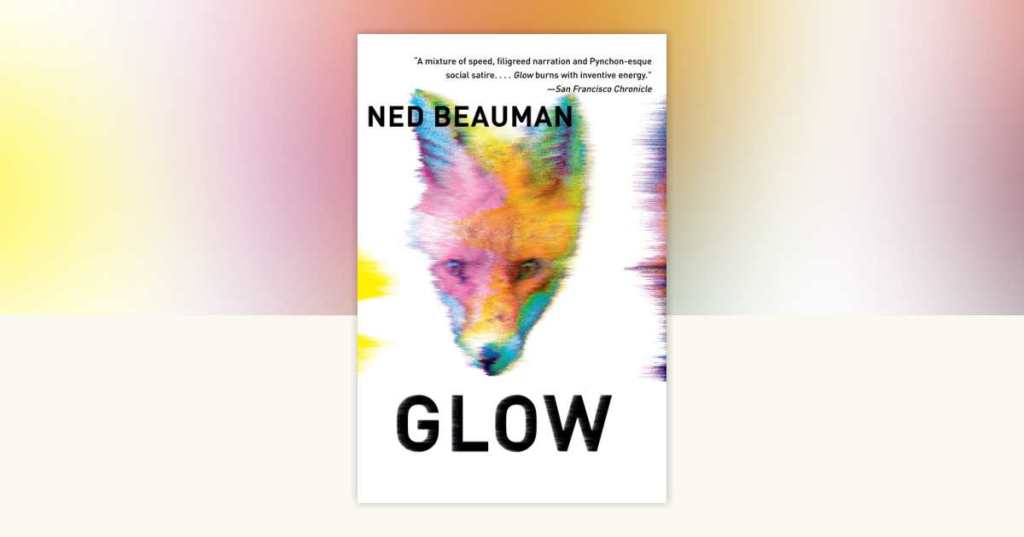
Heartbroken by his recent break-up, he makes up his mind to leave London for good. But his plans take a sudden rain-check when his best friend Theo, the guy that got him the dog-sitting gig, goes missing, becoming one among the recent string of abduction victims of a mysterious white van that’s been sighted roaming around the city. Luckily for Raf, his disorder makes him the perfect man for nocturnal shenanigans. Armed with nothing but a vague clue of his friend’s last whereabouts, he sets out to investigate.
Beauman’s fast-paced prose charts Raf’s efforts across fifteen days, in the span of which he finds himself falling in love with a mysterious half-Burmese, half-American woman named Cherish, and falling right into the middle of a corporate conspiracy that’s about to engulf the city of London. And all of this, somehow, has something to do with a brand new drug called glow, even though no one can seem to get hold of the real stuff.
Right from the beginning Beauman shows us his bona fides, assuring us that we are right at home within the same genre to which White Teeth and many others in its vein belong, which English critic James Woods coined hysterical realism. In what first appears to be a throwaway conversation, Raf and Isaac are discussing why ecstasy – at least the good kind – are hard to come by in London. They pin this to a large-scale confiscation of sassafras oil, a biological precursor to the drug, at a port in Thailand. Raf ruminates:
“Strange, too, to think of the million flirtations that won’t be consummated, the million dawns that won’t be watched, the million comedowns that won’t be endured just because a guy in Laem Chabang neglected to pay a bribe or another guy refused to take one. No politician at a WTO conference ever had so much power. The drug trade, Isaac told him, is the first globalisation of the emotional life.”
And this is, to be sure, a hysterical novel full of bravado and wit, preferring to place its human characters as if pinballs within a giant machine, where the players are the unassailable sentinels of corporations. The abduction of his best friend, and many others before and after him, for some reason most of them Burmese immigrants, are only the stirrings of a larger movement, all pointing to a larger body that’s about to strike.
As clarity sets in on Raf, he finds that the trail that he’s been sniffing around doesn’t lead to some lowlife syndicate with a penchant for highly capacious vehicles. He finds himself face-to-face with a global mining company called Lacebark with a rather tenebrous intent, and whose claws are made sharper with the support of a data mining corporation collecting swathes of information on people that might put a damper on their malevolent designs, such as Raf himself, who they refer to as their “disruptors”.
“You can’t neutralise disruptors just by browsing Facebook. We map the networks ourselves, both online and offline, using super-precise, input-agnostic flow mathematics, and then we figure out how to hit the weak points. It’s like pressure-point fighting – that’s where we got the name. For Suspiria, as a pilot project, we even installed cameras in five nightclubs in LA and used ImPressure®’s facial-recognition module to cross-reference the drinkers with party photos they’d already posted on-line. In one night we got more metadata on local vectors of influence than any conventional market research company could hope to put together in a year.”
Coming across these passages in Glow made me do a double take to confirm the book’s publication date. This being Beauman’s third novel, the publication process must have been much smoother than it would have been for a beginning author. Yet that still means the novel must have been drafted from a full year before, in 2013, before the height of operations of a shadowy joint called Cambridge Analytica, and at least five years before the scandal even broke into the public’s attention.
For those needing a refresher, the scandal centered on mass, unauthorized harvesting of Facebook user data and using it to build psychological profiles for political microtargeting. All this began when a Cambridge University researcher, Aleksandr Kogan, created a Facebook quiz app called “thisisyourdigitallife” that paid around 270,000 to 300,000 users to take a personality test. This gave Cambridge Analytica access to data from tens of millions of users: initially reported as 50 million, later estimated at 87 million, mostly in the US. Users had no idea their data (or their friends’ data) was being shared with a political data firm, having been told the app wouldn’t collect identifiable information.
Cambridge Analytica built psychographic/psychological profiles using information like location, likes, interests, political views, and more. All this information was allegedly used for political campaigns, among them the 2016 US presidential election helping boost Donald Trump’s profile, and the 2016 UK Brexit Referendum. Us in the Philippines were hit hard by the scandal, both in terms of how many users’ data was harvested and because Cambridge Analytica’s parent company claimed it helped elect Rodrigo Duterte in 2016.
About 1.17–1.2 million Filipino Facebook users had their data improperly shared with Cambridge Analytica, the second-highest after the U.S. The firm claimed it could microtarget voters with tailored political messages based on their personality traits and susceptibilities. They found voters were more swayed by toughness and decisiveness than kindness, so it used the issue of crime to rebrand Duterte as a strong, no‑nonsense “man of action” and tough crime fighter.
To be sure, even in 2013 and earlier there have already been signs that the internet, and the increasing bulk of personal information we’ve been filling it with, will soon give way to something sinister. At the time, privacy and legal scholars were already writing about a “surveillance society” where governments and corporations overlap in watching people online. A Harvard Law Review article from 2013 warned that digital technologies create minutely detailed records of people’s lives, enabling massive surveillance and data misuse.
Somehow, by taking the hysterical realist’s paranoiac tendencies in exaggerating the power that companies like Cambridge Analytica/ImPressure® hold over us by weaponizing the information we ourselves volunteer, he seems to have imagined the very tech dystopia that we call every day reality today. Palantir, the brainchild of Peter Thiel, Silicon Valley billionaire, a member of the infamous PayPal Mafia and apparent doubter of the good of human survival, is the perfect example of fiction spilling into reality (it doesn’t help that the name derives from the literal evil all-seeing stone from Lord of the Rings).
Often mislabeled as a “data broker”, Palantir provides engineering support for merging huge, disparate datasets (from many agencies, systems, or companies) into one unified platform, on which they then intend to use AI and pattern detection to find relationships, anomalies, and targets. The company has received over $1.9 billion in U.S. federal contracts since at least 2008, with the Department of Defense being the largest client, and just last year they were awarded a $10 billion contract by the US Army for software and data systems over ten years, with at least $113 million more in new or expanded funding under the Trump administration.
Which isn’t to say that Glow is all doom-and-gloom. Quite the opposite, the story crackles and pops with off-beat humor on more than just the sentence level. What else do we expect from a story about a sleepless junkie playing detective (say what you will but Doc Sportello in Inherent Vice was a real private dick)? From setup to satisfying conclusion, this whodunit serves up a real heaping of entertainment, probably better than any drug (I can’t say for sure, having no experience). It just worries me that in a few more years, if these Silicon Valley tech bros have their way, we may not be laughing for long.


Leave a Reply