I’m generally suspicious of postcolonial works of art that nevertheless utilize the forms of expression — or thrive in the cultural spaces — borrowed from Western powers. For example, while I’m hoping to catch a screening of Rafael Manuel’s much-celebrated Sundance entry, Filipiñana, on my upcoming trip to Manila, my anticipation is already pestered by questions of authenticity: why is this movie, ostensibly about the Filipino experience, seemingly built with Western DNA? [1]
It feels like we’re still at that 1884 dinner with the Ilustrado at the Restaurante Inglés, raising our glasses to Juan Luna and Felix Resurrección Hidalgo’s triumph at the Exposición Nacional de Bellas Artes. Still groveling at the feet of our colonizers for scraps of recognition. Look! Aren’t these nice pictures we’re drawing?
This month’s second film brought similar baggage. Kidlat Tahimik — now a National Artist and celebrated today as the father of the indie scene — was, like Manuel after him, trained in the West. A Wharton MBA, he spent four years as an economist for the OECD. His eventual disillusionment with technocratic capitalism triggered his resignation in 1972, leading to a quaint upstart business selling Filipino woodcraft at the Munich Olympics. That venture collapsed in the wake of the Munich massacre. Stranded, Kidlat sought refuge in an artists’ commune, eventually rubbing elbows with the legendary filmmaker Werner Herzog [2].
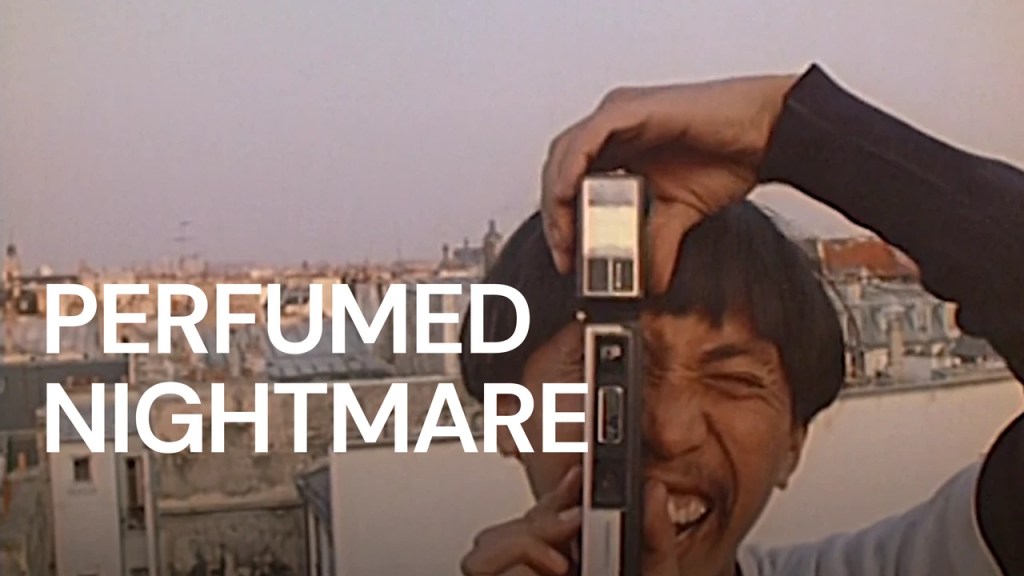
Herzog’s influence would not only bring Kidlat to the world of filmmaking, but his encouragement for the budding artist to trust his own storytelling instincts rather than learning formal film school grammar would give birth to his trademark melangé style. Armed with a second-hand 16mm Bolex camera, film stock scraps, and studio editing time bartered with Philippine seashell lamps, Kidlat began piecing together Mababangong Bangugnot (Perfumed Nightmare) between 1975 and 1977.
The film premiered on June 25, 1977, at the 27th Berlin International Film Festival. In an uncanny historical rhyme, this was the exact calendar day José Rizal delivered his Brindis speech in Madrid 93 years earlier. Like Luna and Hidalgo in 1884, Kidlat arrived in Europe an unknown colonial outsider and left with top honors. But unlike Luna and Hidalgo, whose bona fides rested on their mastery of a Western medium, Kidlat’s film revels in its absolute disregard for European syntax. The film opens with a shot of a cement bridge slicing across a verdant landscape. A narrator details the bridge’s history. This exposition is rapidly spliced with impressionistic flashes: a religious parade, a wedding procession, carabaos luxuriating in mud, uniformed soldiers marching in formation. Then we are back to the bridge. We watch Kidlat himself, dragging a toy jeepney along by a string. He introduces himself:
“I am Kidlat Tahimik. I choose my vehicle, and I can cross any bridge.”
That bridge inevitably leads to Manila, and from Manila, outward. The cinematic Kidlat is an earnest jeepney driver from Balian (now Pangil), obsessed with Werner von Braun, Apollo rockets, and the glittering promise of America. Following that frenetic opening, we next find our hero in his underwear, waking up to a collage of blonde American beauty queens while the Voice of America broadcasts in the background.
The film’s audio landscape is a deliberate, chaotic layering. Dialogue and narration are entirely dubbed over in English. When other characters speak, their native Tagalog is hastily overwritten — literally pasted over — by the English translation. This stylistic choice mirrors Kidlat’s initial optimism, a blind, ecstatic embrace of the future that willfully ignores a bloody history of imperialism. At one point, Kidlat waxes poetic about his jeepney as an “object of war which we turned into an object of life.” He rallies local children for a space club celebrating a rehabilitated Nazi scientist, thoroughly naive to the dark history marring this idol’s past. He marvels at the Sarao Motors factory, the supposed pinnacle of Philippine industry, juxtaposed against a cut of a newspaper headline screaming about 6,000 slashed jobs at Rolls Royce. “You are the master of your vehicle,” he tells his little sister.
Yet, the specter of colonial violence constantly interrupts this optimism. We learn of his father, a kalesa driver turned anti-Spanish revolutionary. After surviving that war and while still singing “the sweet song of freedom”, he was abruptly gunned down by an American sentry, killed for trespassing on American-owned property built on the very land he fought to liberate. As a family friend grimly notes: “For twelve million dollars they bought your soul and mine.”
Enter the American businessman, a frequent passenger taken by Kidlat’s naive enthusiasm. The American offers to bring Kidlat and his jeepney to Paris, dangling the ultimate prize of eventually settling in America as his personal driver. The town erupts in a farewell celebration. Kidlat delivers a grandiose speech, promising to donate a traffic light to the local bridge once he strikes it rich. The sheer, outsized spectacle of this send-off underscores the tragic local perception of ‘making it abroad’ — even if the reality is merely crossing the ocean to become a white man’s chauffeur.
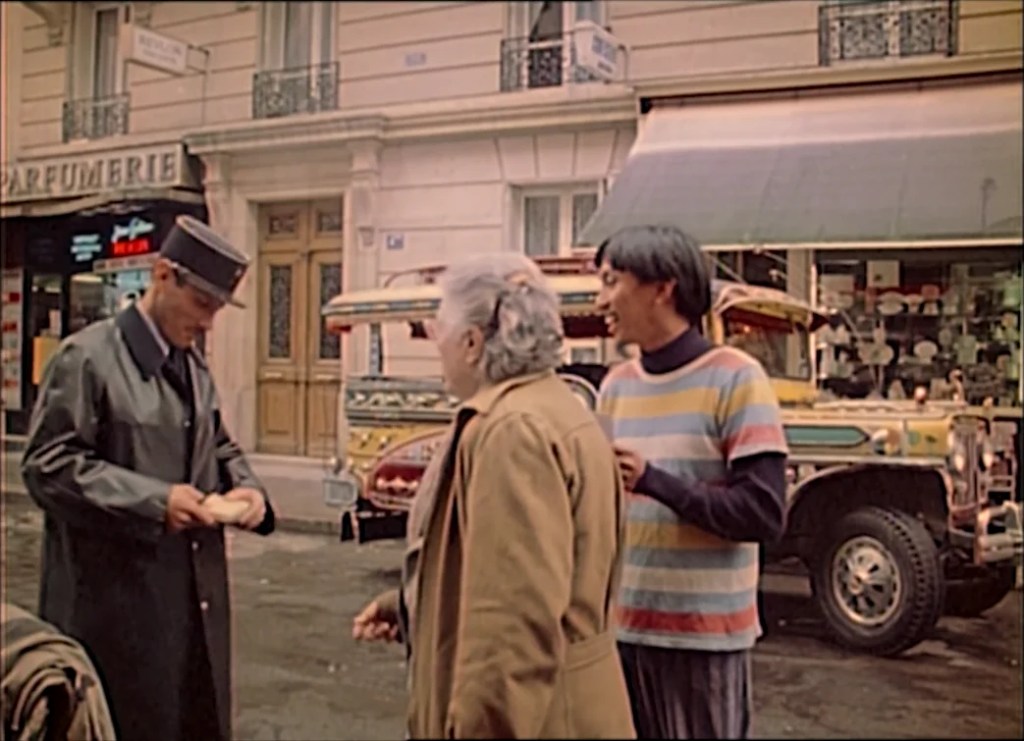
Then he is off. Separated from his family and his best friend, the bamboo artisan Kaya. Kidlat wanders the antiseptic white escalators and skyways of foreign airports. Bridges. Everywhere bridges! Why can’t we have progress like this! He is like a child unleashed upon the streets of Paris. This fictionalization of Kidlat as the “quaint Third World dreamer” works both ways: he gives the paternalistic Western viewer something to smile and laugh at, while he embodies the movie’s central critique towards Western alienation in modernity. And it’s a critique that works because it takes Western technological triumphalism seriously enough to follow it to its spiritual dead end.
Because the Paris that Kidlat arrives at is undergoing metamorphosis. The quaint cherry and egg vendors he befriends are bulldozed to make way for a ghastly, concrete supermarket. Natural eggs face replacement by synthetic alternatives. Even buildings will soon be factory made. But Kidlat is yet confused as to how these Europeans can be so sentimental about the old ways of life, when he is there taking in this new paradise that he has been unleashed upon. But the devastation is relentless. One less vendor means one more parking lot. The forest where Kidlat became a man (underwent circumcision) is razed to make way for a highway.
Liberté. Égalité. Fraternité. Supermarché! The promise of endless growth reveals itself as a terminal disease.
Which brings me back to my suspicions — does Mababangong Bangungot transcend the limitations of post-colonial art? There will naturally be questions about the limits of the film’s success had its wheels not been greased by the presence of Werner Herzog, who championed it among fellow European critics, and further support from Francis Ford Coppola in bringing it to the States via his Zoetrope production company. At the very least, we can empathize with Kidlat in resisting defeat with his refusal to adopt the colonizer’s grammar. Unlike sleek contemporary festival darlings who polish the an aesthetic of Third World poverty to make them go down easier with Western audiences (*coughs*, again see Filipiñana), the movie is shot and assembled as bricolage, refusing Western cinematic standards of dressed-up shots tracking characters through clean, coherent scenes.
The film’s material form perfectly mirrors the all-Filipino jeepney: an unruly, patched-together assemblage salvaged from the empire’s discarded parts. It actively denies the metropolitan viewer a seamless, passive consumer experience. Escaping the traps of the tragic victim narrative and the pedantic postcolonial lecture, Mababangong Bangungot operates as an act of pure cinematic sabotage wrapped in a folktale. It refuses to let the colonizer dictate the terms of the conversation. And yet it is never boring. The fast cuts of unscripted footage, the folk music, the wondering camera. Mababangong Bangungot is, in other words, an act of pure style.
Notes
[1] For those that don’t know, Filipiñana, is based on a 2020 short film that Manuel submitted as a graduation thesis film at the London Film School. Winning the Silver Bear at the 2020 Berlinale put Manuel through the Western Prestige hubs like the Cannes Cinéfondation’s La Résidence, the Berlinale Script Station, Film4, the BFI Network, and the Rolex Arts Initiative (where Manuel was mentored by Jia Zhang-ke). It only reaches the domestic Philippine market now, after it has been through all the top-tier Western circuits.
[2] Herzog would even cast him as “Hombrecito”, the quiet, flute-playing indigenous man in The Enigma of Kaspar Hauser (Jeder für sich und Gott gegen alle, 1974).


Leave a Reply