It’s finally September! Not only is my birthday coming up, but the month also happens to be Philippine Film Industry Month (PFIM), so chosen to commemorate the birth of Philippine cinema following the screening of Jose Nepomuceno’s Dalagang Bukid in 1919. Readers of my blog would know that I’m a big fan of our local cinema, be it the little-known gems coming out of the festival circuits or veritable blockbuster hits by Jerrold Tarog or Erik Matti. To celebrate, I’ve dedicated the entire month’s watchlist to select films that made an indelible mark on our country’s cinema, hopefully culminating with me attending one of the free screenings and film talks that the Film Development Council (FDCP) is holding at the Cinematheque Centre in Manila.
We’re starting strong this week with a classic. Itim (1976) represents a prodigious feature-length debut from legendary filmmaker Mike De Leon. It’s a landmark of Philippine gothic horror, mining the country’s storied relationship with Catholicism and the occult to produce a pervasive sense of dread looming in its every scene, setting up the template to be followed by pretty much every iconic Filipino horror movie in the decades since (think: Chito S. Roño’s Feng Shui and Erik Matti’s Seklusyon).
The film’s genesis and restoration is in itself a story worth telling. In a retrospective interview, De Leon recalled his transition with Itim to the director’s chair right after completing work (as producer) on Lino Brocka’s Maynila, Sa Mga Kuko Ng Liwanag (1975), another second golden age favorite of mine. For his first film, he wanted to explore the same supernatural subjects initially covered by his short film Monologo, a 1975 homage to Blow-Up, drawing inspiration from Lafcadio Hearn’s ghost stories and Jack Clayton’s The Innocents.
Unfortunately, the Philippines hasn’t been very good at preserving its cinematic gems, a fact not helped by the extreme heat and humidity that the country is known for. A vast majority of our country’s catalogue of classics have been lost, be it due to careless handling or natural accidents like fire and flooding, and Itim survives today thanks only to negatives that had been stored at the British Film Institute (BFI) archives. Elated at having found the prints in good condition, De Leon initiated a 4K restoration in partnership with the acclaimed Italian laboratory L’Immagine Ritrovata. The resulting cut was then reintroduced to the world with a world premier at the 2022 Cannes Film Festival.
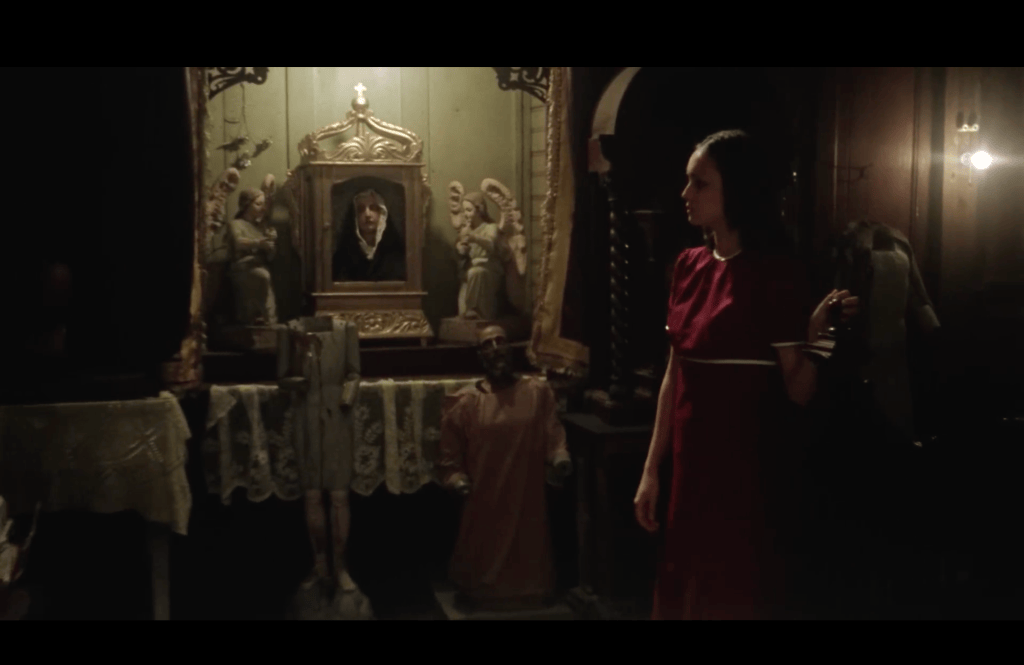
Set against the backdrop of Holy Week (giving rise to its anglophone title, The Rites of May), the narrative follows a young photographer (Tommy Abuel) who has come home to the province of San Ildefonso to visit his father, paralyzed after an accident many years ago, as well as document the town’s Holy Week rites for a magazine assignment. There, he meets and becomes romantically involved with a mysterious young woman named Teresa (Charo Santos), but their budding romance seems burdened by ghosts neither of them understand — at least, not yet.
One wonders if, true to his word, Mike de Leon really had no idea the film could be read as anything more than a ghost story, that it serves also as a meditation on a country still haunted by its brutal, colonial past, when the film is suffocated with religious imagery, featuring a large and imposing Spanish colonial house crumbling into dust and ashes. Early on in the film, Aling Bebe, the Torres family help says in response to Jun berating her for still attending to chores ordered by his long-dead mother, “‘Pag hindi nasunod ang hiling ng patay, hindi matatahimik ‘yan (if the dead’s wishes aren’t followed, they won’t be at peace),” signaling early on the chokehold that these ghosts continue to have on our present and future.
Jun first meets Teresa while taking photos of a pabasa around their neighborhood, one of the iconic rites of May in which attendees take turns chanting lines from the pasyon (Christ’s passion). He finds her standing among the chanting crowds and snaps a photo of her. Later, we find that Teresa, who is not actually a resident of that town, only wandered into San Ildefonso having been out of herself all evening. They meet again later at a church. Jun offers to give her a ride back to her house, and that’s how he comes to learn about Teresa’s sister Rosa, who disappeared years ago and is now presumed dead.
De Leon’s impeccable cinematic vocabulary is in full display with Itim. Rather than beat us over the head with expository dialogue, the film builds mystery and suspense with deliberate use of juxtapositions. One of my favorite moments happens right after Jun and Teresa’s initial meeting, while Jun is developing his photos in his dark room. The deep red silhouettes are cut by the sharpest shadows you’ve ever seen, making it nigh unbelievable the movie was shot using film cameras from the seventies. Apparently shooting the original relied on aggressive post-flashing techniques to achieve this very effect.
The camera cuts between Jun in his dark room, and his father restlessly in the bedroom right above him, to the accompaniment of an orchestral music playing via the portable cassette player Jun brought over from the city as a gift. When one of the photos finally comes to form, revealing the face of the possessed Teresa, we cut immediately to the old man, eyes open, in the throes of a nightmare. And like waking up from a dream ourselves, we begin connecting the dots between the elder Torres’s accident and Rosa’s disappearance. What, we wonder, do these events have to do with each other? And what role will Jun and Teresa play in this story?
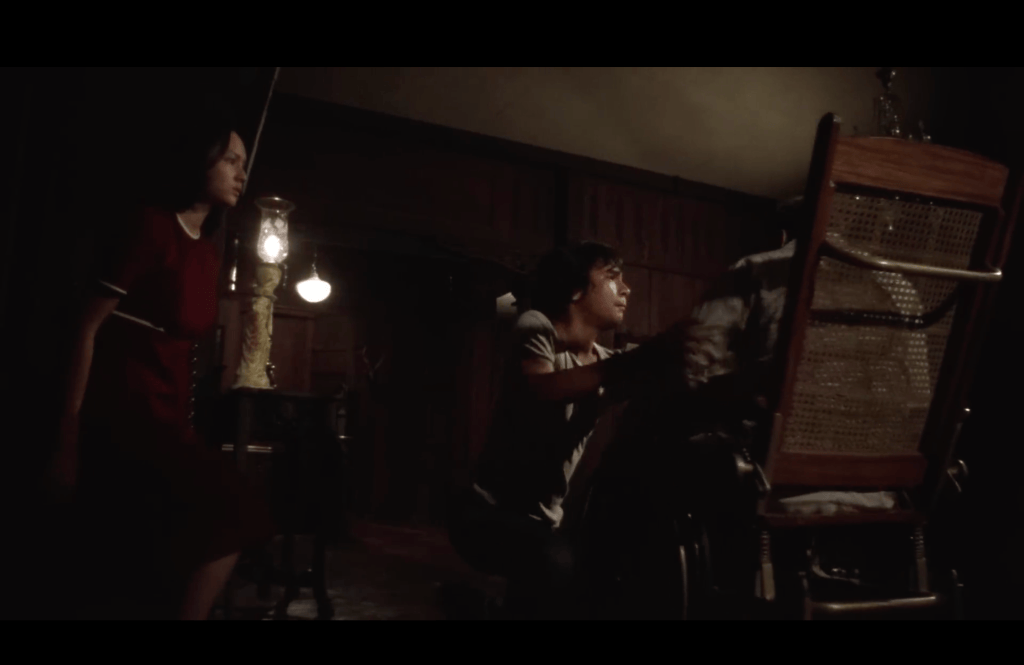
The movie is testament to fact any Filipino kid would have learned throughout childhood: that nothing is scarier than the church. To wit: the film uses almost no jump scares throughout its 105 minute runtime. A ghost haunts the neighborhood, and our triangle of primary characters, but there are no wispy white ladies or bleeding ghouls here. Just sudden cuts to the blank face of a Sto. Niño is enough. Dark rooms in an old, crumbling house littered by religious icons and stationery saints — what could be creepier than that?
There is also the matter of Jun appearing to be a tourist in a province he’s been away from for who knows how long. While doing his photography assignment for the magazine, he is constantly getting in the way of the locals going about their rituals in earnest. Coming back from Teresa’s house after their first meeting, he stops his car before a penitensiya (another rite, this time having volunteer participants taking on the role of Christ in the moments leading to his crucifixion), and he takes a kind of exoticizing stance towards them. An act that one assumes he would have grown up witnessing before his eventual exodus to the city appears to him not only unnatural, but distressing.
This is a very strong start to my month of Philippine movies. But then again, the period spanning the 1970s to the end of the Marcos regime in the 1980s are known to be the country’s second golden age of cinema for a reason. If you are interested in seeing Itim it’s showing this month at the Cinematheque Centre Manila near Intramuros for free thanks to the FDCP. Here’s hoping they put this up on streaming soon, if they haven’t already.


Leave a Reply