I’m going to just go ahead and open this post with a scalding hot take: artists have no obligation to validate all sides of an argument. This applies to any medium of creative expression, be it essays, film, short stories, novels, or hell, even polemical tracts. If you’re writing jurisprudence, sure. But if you’re producing a film whose central politic is supposed to center on the dystopian levels of oppression that women face in a society that dictates what they can and can’t do with their own bodies, both-sidesing the core argument will only have said film shooting itself in the foot.
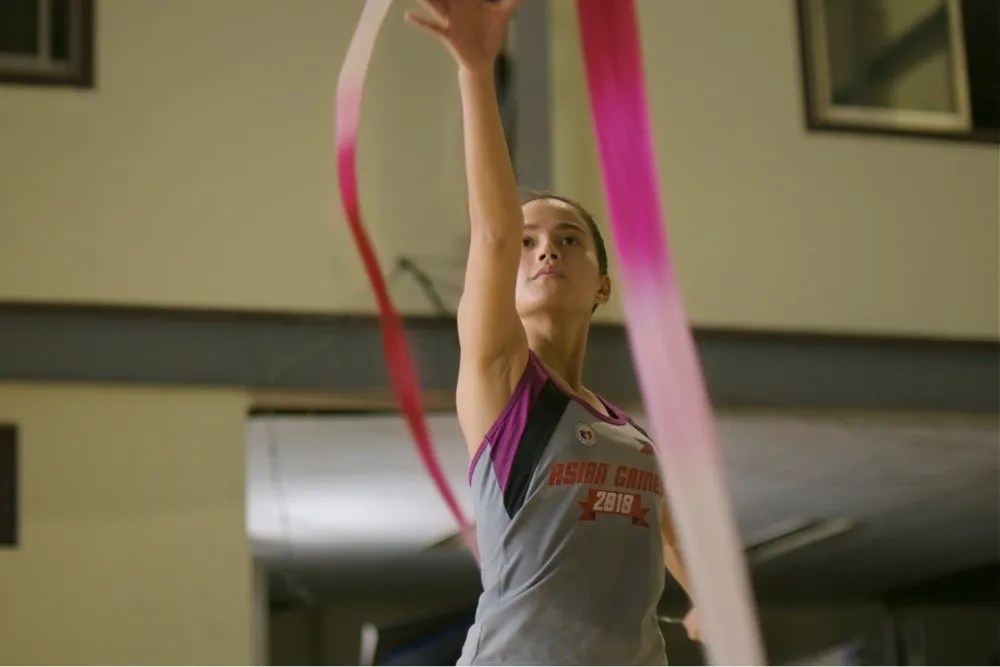
This is my main problem with Sunshine (2024), a coming-of-age sports drama from blockbuster darling Antoinette Jadaone. It stars Maris Racal in the titular role of nineteen-year-old Sunshine Francisco. When we first meet her, she’s training for what is ostensibly her final shot at making the national Olympic gymnastics team, with tryouts just around the corner. A beautifully choreographed montage shows us Sunshine is pretty good at what she does, executing complex moves with bravura, only something seems to have gone wrong with her. Just as her act reaches an upswing, Sunshine faints, and we the audience immediately understand that an earlier remark from her coach about her gaining weight is a symptom of something else.
Cue a scene of Sunshine crying on a jeepney ride, telling the driver she’ll ride “wherever” (“kahit saan na lang po!”) in clear parody of the same melodramatic taxi scenes in Hollywood movies, and looking up various shady accounts peddling abortifacents and related life hacks (one post recommends she down multiple bottles of Red Horse beer in quick succession) on platforms like Twitter. Finally, she comes upon a pharmacy, and at her request for a pregnancy test the first of the store’s two clerks immediately asks for identification, berating her generation for being a bunch of careless horndogs (my words, not hers). Sunshine almost runs away if not for the kindness of the second clerk, who does sell her the kit.
This is the kind of world Sunshine and the millions of Filipino women she represents face on the daily: a dystopia where mere commerce is elevated to the level of grace. Said pregnancy test finally confirms, in no uncertain terms, Sunshine’s dilemma. She is pregnant. And her boyfriend, aptly named “Miggy”, wants nothing to do with it. Meeting up outside his campus he asks her to just “get rid of it”, as if it were just as easily said as done.
Because the Philippines is so heavily steeped in the traditions of dogmatic Catholicism, with a view of body autonomy and women’s roles in society so backwards it’s outright dystopian, abortion is illegal everywhere in the country. Abortion is penalized under the 1930 Revised Penal Code (Articles 256–259), which provides zero legal exceptions by which the operation may be deemed permissible. It is a crime even if the pregnancy is the result of rape or incest, if the fetus has fatal impairments, or if carrying the pregnancy to term directly endangers the woman’s life. A woman who undergoes an abortion faces between 2 to 6 years in prison (prision correccional).
This draconian framework, it should surprise nobody, doesn’t actually prevent abortion from happening. It only makes it unsafe. According to data from the Guttmacher Institute and reproductive health NGOs, approximately 1.1 million induced abortions occur in the Philippines every year. These are done via abortifacents and other shady substances that cause more harm than they’re worth, well outside the controlled and sterilized environment of a hospital operating room. An estimated 1,000 Filipino women die every year from complications related to unsafe abortions (such as hemorrhage, sepsis, and organ damage).
For those in the elite and upper-middle classes, the restriction can be but a minor inconvenience. A woman from a family with suitable means may, for instance, decide to simply fly abroad and have the operation elsewhere in the world that isn’t stuck in the 1800s. But the statistics show that roughly 75% of Filipino women seeking abortions are from low-income or rural backgrounds. Welcome to the Philippines, where quality of life is only for those who can pay. The poor are left to navigate a labyrinth of dangerous, unregulated herbal remedies and black-market pills, which are iconically sold, of all places, outside the historic Quiapo Church.
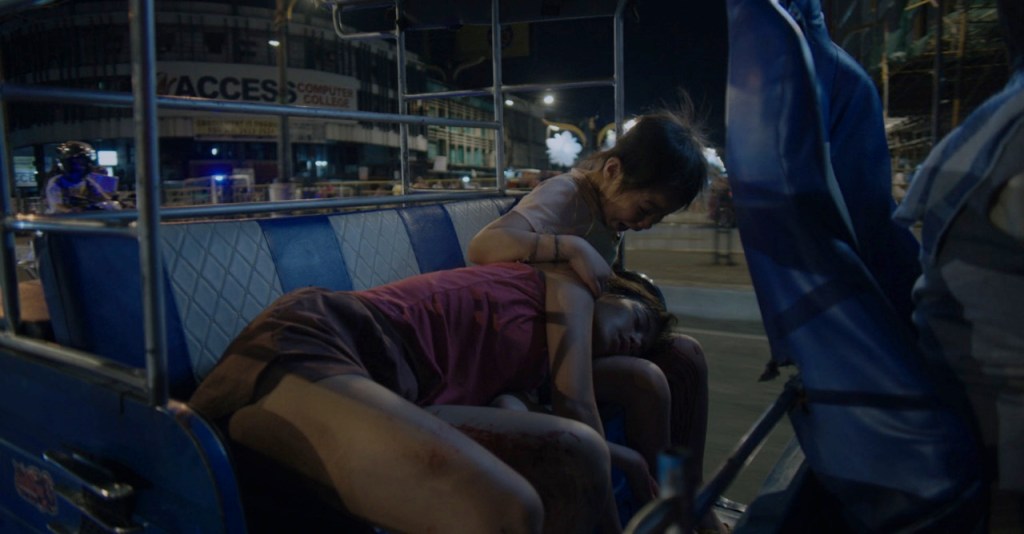
All this adds to the frustration that my wife and I had while watching the movie. Given the milieu from which it emerges, Sunshine was in prime position to raise awareness and begin some kind of momentum towards a societal reckoning with this private hell that our male-dominated church and state infrastructures continue to preserve for their women. We follow Sunshine as she strengthens her resolve to finally purchase an abortifacent from a lady selling religious images outside the church, checking into a room at a shady motel along Avenida to accomplish the deed once and for all. The night ends in disaster: the next we see Sunshine, she is in the back of a pedicab, fighting for her life, while a random stranger drives her to the nearest hospital.
Up until this portion of the film, Jadaone has been very disciplined in her control of the material. Not quite masterful — some of the dialogue can be grating to the ears, a lot of it being delivered in the high pitch shrill that has become, for some reason, a hallmark of Tagalog comedy. But she has made us adore Sunshine, the young athlete who just really wants to become an Olympic gymnast, and brings us along to this horrific descent. We agonize with her. Look at this, she whispers into our ear as she points at Sunshine, having just come back to her senses at the hospital after having narrowly survived her ordeal, only to then be berated by a middle-aged female doctor for having committed a grave sin in the eyes of the Lord, and telling her to pray for forgiveness. This is the lengths we force young women like her to go.
And she doesn’t give us an easy out, either. One might — although one shouldn’t — brush off Sunshine’s plight as being merely consequences. She made a mistake. Now she must deal with the product of that mistake. But must a night of lapsed judgment really be so permanent? Either way, somehow not entirely discouraged just yet, Sunshine comes back to Quiapo after recovering to get an even stronger substance. This is when she meets Mary Grace, a woman from an even poorer background, who we learn is months along the way after having been — and trust me, I hate to use the word, but any other would lighten the situation unjustly — raped by her uncle. In the eyes of the law Sunshine and Mary Grace’s plight are one and the same. Church and state deny an out from both the misguided that just made a wrong turn somewhere, and the victims who were forced into that same corner through violence.
Then Jadaone drops the ball. Earlier in the movie, when Sunshine first comes to Quiapo to stake out the stalls selling the banned substances, she meets a young girl who, despite ostensibly living in the streets, speaks in the same conyo register as Sunshine. She tails Sunshine through some of the film’s key moments, chiding Sunshine for her resolve to do something “immoral”. Later, when Sunshine decides to give Mary Grace some of the money she had reserved for her own operation so she can go to a faith healer who can supposedly help her (Mary Grace) lose the baby, the girl meets another young kid on the streets, a queer boy who calls himself Ariana. Ariana tells the girl and Sunshine that she dreams of one day becoming the country’s first gay president.
It’s all played out for laughs in an attempt to lighten up the movie’s tone after having just delved into Mary Grace’s brutal reality. Some commentary that I’ve seen online suggests Jadaone had written these moments with the girl and Ariana into the movie with inspiration from Jojo Rabbit (2019). But whether Jadaone realizes it or not, introducing Ariana and, to a slightly more excusable extent, the girl, introduces a pernicious element to the narrative that only serves to muddle the film’s politics. After our brief introduction to Ariana, he suddenly becomes overtaken with distress. Thus begins a mad dash to the house where Mary Grace was undergoing her operation with the faith healer, and Ariana vanishes just as we see Mary Grace being carried out of the house by panicked neighbors into a van, lifeless and bleeding between her thighs.
This is where the unease that my wife had been feeling since the little girl’s introduction finally reached a limit. By introducing the girl and Ariana as the magical but nevertheless tangible personifications of the unborn infants then living in Sunshine and Mary Grace’s wombs, and by explicitly portraying Ariana’s disappearance as Mary Grace successfully goes through with the abortion, Jadaone pretty much handed her opponents the keys to the bulldozer that topples everything the movie had built up so well until this point. She had just validated the naysaying refrains of the characters the movie had previously been satirizing, and the real world politicians and masses that are against the film’s political core.
Discussing the movie at length afterwards, my wife concluded that had Jadaone stuck with just the girl — no Ariana — it might have been salvageable. The girl could have simply remained a personification of the Catholic guilt that’s been deeply embedded by years of education and cultural conditioning into Sunshine and the hundreds of thousands of women every year that find themselves in her situation. This might have given the final montage of Sunshine back at the gym, performing what would have been her crowning achievement after years of dreaming and hard work, a touch of self-forgiveness and actualization. The scene of the little girl hugging Sunshine while crying, “I get it”, could have instead become a moment for Sunshine to reconcile with herself the lengths she had to go through to reaffirm her autonomy, rather than one of forgiveness between a hesitant mother and the child that would be.
Sayang, as we would say in Tagalog. Sunshine’s story could have made for such a monumental piece in Philipine cinema. To be fair, this is still a beautifully made film. The humor and the psuedo magic realist middle act may not be for everyone, but it carries itself well. Maris Racal helmed the leading performance with bravado. It raises uncomfortable questions that are long overdue in the country’s psyche and, thanks to its run at the international festival circuits, sheds light on the sordid reality of Filipino women live through everyday. It was very good, until it wasn’t.
Stray Thoughts
When Mary Grace is taken to the hospital, Sunshine finds herself at the receiving end once again of even more lecturing, this time from a male doctor who refuses to operate on her at risk of losing his license. Apparently this is one more thing that women and their families must deal with. An abortion is illegal, sure. But if an attempt at abortion goes south, doctors attempting to provide protective care also put themselves in a tenuous situation. Under Article 259 of the Revised Penal Code, physicians or midwives who assist in an abortion face up to six years in prison, professional disciplinary action, and the permanent revocation of their medical licenses.
Strictly speaking, medical ethics and Philippine emergency care laws dictate that doctors must treat patients suffering from life-threatening emergencies, including post-abortion complications. Providing emergency care to stop a hemorrhage is not legally the same as performing an abortion. However, the severe criminalization of abortion creates a massive chilling effect. Because the line between “treating an ongoing complication” and “assisting in an illegal abortion” can be legally blurry, many doctors operate in extreme fear of prosecution. In the film, it was only fortunate that another doctor, a woman, was at the scene and willing to assist. Despite the gravity of the situation, for the men in this movie, like the doctor or Miggy, it is only a matter of doing or not, of being involved or at a distance. Always it is up to the women to come together and help each other.


Leave a Reply