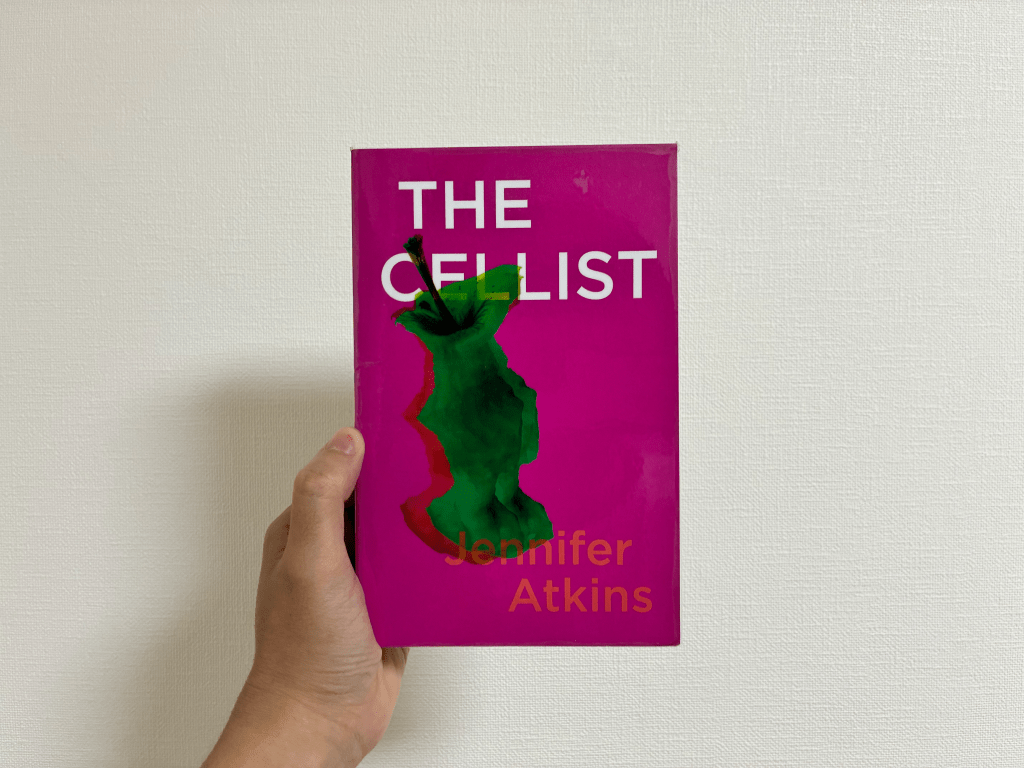
There is a specific, quiet thrill that comes with picking up a debut novel. You open the first page completely untethered from an author’s past baggage or established tropes, ready to be taken in by whatever voice they’ve chosen to introduce themselves to the world. It’s a feeling not unlike the stillness of a concert hall just before the conductor raises their baton. A pregnant anticipation where anything is possible. This week, that silence was broken for me by Jennifer Atkins’s debut, The Cellist.
It tells the story of a nameless female cellist and her increasingly suffocating relationship with her partner, Billy. While she travels the world playing high-profile concerts and receiving the adulation of the classical music scene, Billy is a sculptor, spending his days in his workshop carving bodies out of plaster. From the outset, the novel positions itself as a dissection of artistic passion, treating the dedication to one’s craft as a kind of erotic, almost sexual act. The narrator describes the indentation that the curve of her cello leaves on her thighs, of her sweat mingling with the wood of her instrument.
But where there is passion, there is inevitably the shadow of ego. Atkins immediately zeroes in on the gendered dynamics of ambition. Early on, our narrator makes a striking observation about the nature of desire:
“There was a shame in wanting things too openly – I’d learnt this through watching others enact their desires – so I worked in silence. I woke at six, back aching, to play for a few hours before I left for rehearsals each morning. It was at the hour I noticed the year turning, every day the sun a little stronger.”
It’s a beautiful passage, but it highlights a persistent reality: such shame tends to be overwhelmingly directed towards women. Men, historically and culturally, are rewarded for their “passion,” for being unapologetic in their pursuit of achievements, property, and the women they desire. When Billy takes her to his workshop, the narrator experiences a feeling akin to jealousy towards the plaster bodies taking up his time and energy. She wants him to see her as a sexual presence, for her living form to take precedence over his art.
Billy, in turn, harbors his own resentments towards her success. At a post-performance gala, he feels utterly lost and alienated when other people constantly mention her name, admitting later that he thought he would only feel pride, not this creeping inadequacy. Which brings us to the central tension of the book: will artistic jealousy ultimately be their relationship’s downfall?
Atkins’s narrative voice is arresting, to be sure, but it is also where the novel begins to stumble into frustrating territory. Everything in this book – every event, and even most of the dialogue – is heavily intercepted and filtered by the narrator’s mind. So much of the story is reported rather than seen. As a reader, I found myself starved of the space to assess the details for myself, to wonder at some off-hand remark or physical gesture, or even to adjudicate on the narrator’s own sincerity.
Case in point: there is a scene that appears to be a critical turning point in their relationship. They are having dinner with another cellist, and Billy has to intercept highly personal and supposedly combative questions directed at the narrator. She feels deeply humiliated, both because she is reduced to someone Billy had to protect, and because she genuinely needed his protection. It should be a profoundly poignant moment. Yet, we are never told what the questions actually were. We don’t see how Billy approached them. Did he diminish her in his defense? Did she shrink into a small thing between these two men, even though she is the one who shares the other man’s professional stature? Who knows. So much is teased, but so little is actually shown.
This intense solipsism spills over into how the world is populated. Aside from Billy (and a character named Luc), almost nobody in this book has an identity. They are referred to strictly by their utility to the narrator’s orbit: “the composer,” “the artist,” “the poet.” She names historical figures – Barenboim, Janáček, Eastman – but the living, breathing people around her are stripped of their names. It’s as if, to her, no one else is truly real unless they are art itself.
The thematic peak of the novel, and perhaps its most telling structural metaphor, happens during a boat trip along a waterway connecting King’s Cross. Billy’s simmering jealousy finally boils over into outright hostility after she returns from a successful stint in Philadelphia.
“Are you boasting?” he said.
It took me a second to understand him.
“About America?” I replied.
He shook his head. “It doesn’t matter.”
He confesses that strangers in America wanted to see her, while his own father didn’t even want to see him. In an interesting counterpoint, they had just been listening to a piece by the avant-garde composer Julius Eastman. The narrator describes the piece as atonal, containing unpredictable dissonances: an ensemble of ten cellos that begin by playing the exact same line of music, only to eventually diverge into a chaotic counterpoint while remaining harmonically related. It is a masterful bit of foreshadowing for the couple’s relationship: two artists unable to extricate themselves from each other due to their shared creative frequencies, yet diverging wildly in their trajectories.
As an aside, coming across this passage sent me down a rabbit hole, ending up with me watching a YouTube documentary on the tragic erasure of Julius Eastman from music history: a fascinating, if sobering, real-world parallel to the novel’s themes of whose art gets remembered and whose gets marginalized.
Also, this scene struck me as particularly humorous, having been in London for a conference this past December and making not a few detours through the King’s Cross area. Admittedly I was there for a very short time, and throughout was constantly shuttling from one tourist spot to another, trying to see as much as I could in between breaks from the conference, but I somehow completely missed the fact that there was a navigable body of water anywhere nearby. As it turns out, the Regent’s Canal runs right behind the station, an entire aquatic artery hidden just out of sight from the usual commuter rush.
But back to the book, following the death of Billy’s father, the couple moves to Spain, and the narrator suffers what she insists is a “panic attack,” though others view it differently:
“That was his word, even though I’d told him it was a panic attack. He continued to use that word even after I corrected him, and many other people also used their own words to describe what had happened, but I did not recognise these words, could not tie them to myself.”
Following this incident, the narrator transitions from merely self-absorbed to outright insufferable. It is as if she expects the entire world to stand in moral attention to her suffering, becoming furious when people refuse to walk on eggshells in her presence. I suppose this trajectory was incoming from the very beginning, but it makes the final act of the book an incredibly grueling read.
The Cellist is not a book I would recommend to someone looking for a breezy, romanticized take on the life of a musician. It is a challenging, claustrophobic text that demands you sit inside the head of a narrator who refuses to give you the full picture, and who might just be impossible to like. But as a dissection of how ambition and jealousy can curdle a romance, and how the pursuit of high art can isolate us from the basic humanness of those around us, Atkins has delivered a debut that, for better or worse, is very hard to forget.


Leave a Reply