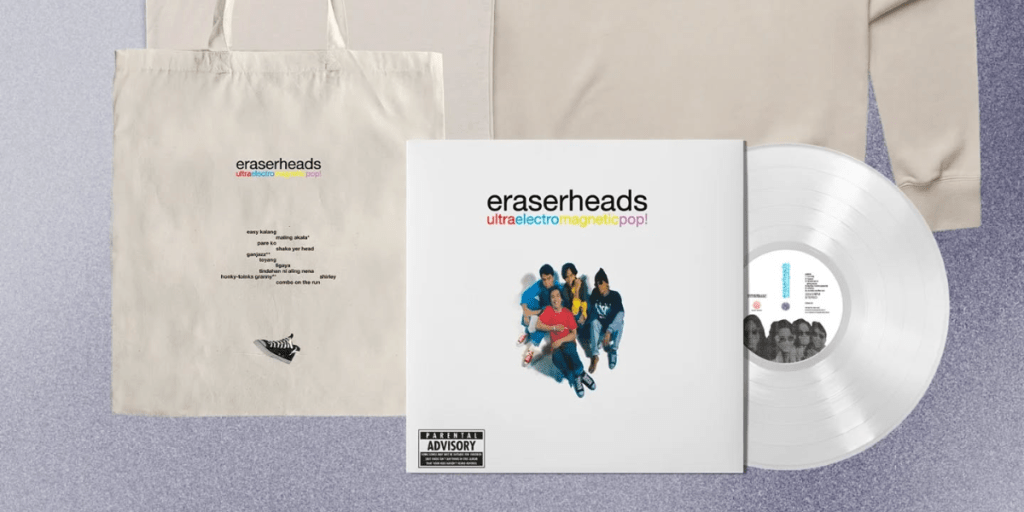
There has been considerable online buzz surrounding the 2025 documentary Combo on the Run, framed as a deconstructionist retrospective on the mythic rise, fall, and long-lasting cultural impact of the Filipino alt-rock band Eraserheads (referred to endearingly by fans as the E-Heads, or simply the Heads). This renewed interest coincides with the documentary finally hitting Netflix this May, alongside the 25th-anniversary repressing of the band’s debut album, Ultraelectromagneticpop!, via Offshore Music – the independent label founded by the Heads’ frontman, Ely Buendia. Having just received my salary, and with a brief window of denial before my utility and credit card bills demanded attention, I purchased a copy for my growing vinyl collection (a logistical nightmare I will eventually have to grapple with when shipping these back to Manila from Japan) along with a commemorative crewneck sweater. Figuring I might as well reactivate my Netflix subscription for the month, I finally sat down to watch the film.
It remains baffling to me that it took this long to press play. Although a latecomer to their catalog, I converted almost instantly into a superfan during college, courtesy of a bootleg Spotify app (procured through my mother’s old college friend) that granted unpaid premium access. College proved the perfect incubator for appreciating the lyricism of Buendia and drummer Raimund Marasigan – our country’s answer to Lennon and McCartney (expect more Beatles comparisons shortly). I head-bobbed the pain of unrequited love away to the profanities of “Pare Ko” and drove my parents wild with the screeching, surf-pop chaos of “Alkohol.” I even stalked the campus in a t-shirt printed with the iconic chorus of “Sembreak” (Naalala kita, pag umuulan / Naalala kita, pag giniginaw / Naalala kita, pag kakain na), a shirt tragically lost as collateral damage during a breakup with a college ex.

Directed and produced by Maria Diane Ventura (Buendia’s manager and partner during the band’s tumultuous years), the project supposedly took shape in the aftermath of the record-breaking Huling El Bimbo reunion concert in December 2022, which the film boasts as the biggest concert yet witnessed in Manila. Ventura filmed the band over the next two years, capturing subsequent world tours and conducting deep retrospective interviews. The documentary interweaves these recent conversations with gritty archival footage of their mid-nineties prime, showing young Ely, Raimund, Marcus Adoro, and Buddy Zabala tearing through sets at cramped watering holes and sold-out festival grounds during the multi-platinum Cutterpillow era. Describing the process, Ventura notes, “Each interview revealed new layers and complexities, which found us constantly reframing to deepen the narrative.”
Despite touting itself as a deconstructionist take on the band’s complex history, the documentary achieves the exact opposite. Rather than reveling in the messy reality of young, fiercely creative, and egotistical men grappling with mainstream fame, Ventura smooths out the creases. She sandpapers the sharp edges to present a clean, mythical canonization of the Eraserheads as post-EDSA alt-rock legends. It is a story engineered to send both new and veteran fans running to secure a 25th-anniversary vinyl while crossing their fingers for another reunion tour. Much like the Beatles’ Anthology project or Peter Jackson’s Get Back, Combo on the Run functions fundamentally as hagiography. Its primary goal centers on gesturing to these four individuals as a lightning strike of pure cultural magic. The conflicts between the band’s burgeoning musical sensibilities and corporate demands, alongside their interpersonal inability to navigate sudden national stardom, are glossed over in favor of absolute reverence.
But we’re getting ahead of ourselves. Who are the Eraserheads? The Netflix release features several edits designed to make the narrative accessible to international audiences or uninitiated viewers at home. The documentary wastes no time rehashing the origin myth of Ely Buendia, then a sophomore at the University of the Philippines, posting an ad on a university message board that only his three future bandmates would answer. They emerged from the political tumult of the post-EDSA years, riding the upswing of a growing underground rock scene nurtured by storied venues like Mayric’s and Club Dredd. The Philippine music scene, much like the greater political mainstream, desperately needed an overhaul, and the Heads answered that call.
One thing we cannot deny the Heads is that they are one of a few bands that can truly be described as iconic – which is to say, their career has been marked not only by highly successful multi-platinum hits like Ang Huling El Bimbo and its accompanying music video directed by Aureus Solito, but also by specific, indelible pop-culture moments: their rowdy performance on the Sharon Cuneta show; the senate uproar over the supposed pro-drug lyricism of “Alapaap” and a subsequent meeting with Senator Tito Sotto; the persistent, albeit repeatedly denied, urban legend connecting “Spoliarium” to the Pepsi Paloma case; and Buendia collapsing from a heart attack at the end of their 2008 reunion set. These events form an unassailable metanarrative defining their cultural legacy. And Combo on the Run capitulates to this very metanarrative rather than attempting to dismantle or even make a very small dent in it.
In critical theory, a metanarrative (or “grand narrative”) serves as a global, overarching ideology that schema-organizes smaller, fragmented experiences to give them collective meaning and legitimacy. Largely attributed to French philosopher Jean-François Lyotard in his seminal work, The Postmodern Condition, the concept acts as a grand framework through which a culture interprets history, behavior, and art. When applied to popular culture, a band’s metanarrative transcends the chronological timeline of their career. It constitutes the constructed, overarching mythos framing how their songs (hits and flops alike) are consumed, dictating the cultural weight, artistic purity, and ultimate legacy of the creators.
When the sonic departures of their more conceptual, more edgy output like Fruitcake or Carbon Stereoxide confused the general public, the hardcore fanbase adopted an intellectualized reading. The consensus dictated that the band was deliberately challenging their audience, operating on a frequency that was already too advanced for the masses. This pervasive mythologizing conveniently obscures a much more ordinary reality: the Heads were already on their way out well before they broke up. As evidenced by the above two albums, the massive, generation-defining hits were becoming significantly fewer and farther between. Their late-era output broadcasted a growing disenchantment with the polished pop-rock that made them famous (what they would themselves describe, in their Natin99 song, a Pop Machine), colliding head-on with a listener base wholly unconvinced about following them down any new avenues. The abrupt breakup effectively rescued the band from a slow creative fade, freezing them instead at the absolute apex of their cultural currency and power.
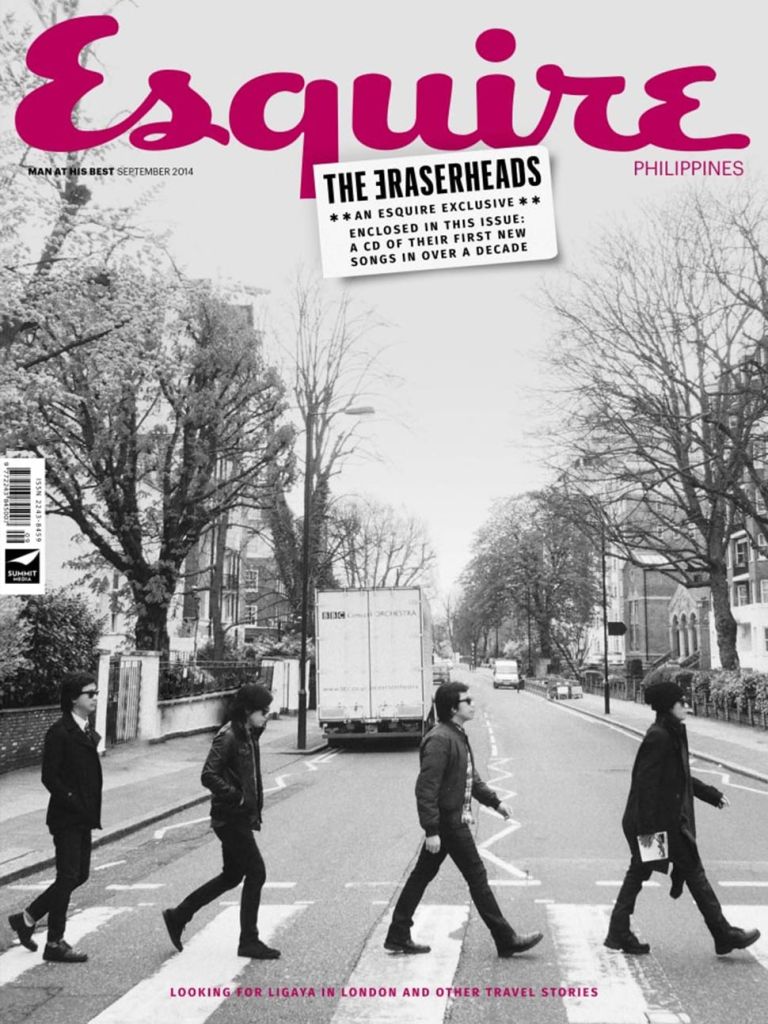
Following the dissolution, the members cultivated a strict artistic distance from the Eraserheads legend. For years, they actively dodged suggestions among peers and the press about the possibility of a full-blown reunion, opting instead for circuitous half-measures. They would tease the public with billed “collaboration” performances abroad, or share a local stage while sequestered within their subsequent projects (Pupil, Oktaves, Sandwich, the Dawn, Markus Highway) carefully sidestepping the massive gravitational pull of the original brand. As one article observes during one of their exclusive performances,
“Playing before an exclusive guest list at the Dusit Thani in Manila, the foursome was adamant that they were not officially playing together as their old band. They told viewers, “This is not the Eraserheads. We are not the Eraserheads,” before calling out names of their current bands.” [source]
Because the Heads actively engineered and maintained this scarcity, their rare public alignments command a kind of religious reverence. Fans view a reunion concert as a finite, precious resource. Combo on the Run taps directly into this dynamic. A truly critical documentary would have dedicated more space towards interrogating the attendant pressures of the 90’s Manila music scene, clashes against the demands of corporate sponsorships, and the uneven distribution of creative control that led to the group’s dissolution. The film romanticizes and historicizes their internal friction instead. The distance between the members is framed as the inevitable tax on genius.
By utilizing separate, non-overlapping interviews where the bandmates reflect on each other from a distance, the documentary structurally reinforces their unavailability. To be fair, the film does prod at uncomfortable fractures, but the disconnected format ensures there are never any real stakes or actual tension to resolve. Ely and Raimund reminisce on the aborted 2008 concert, touching upon the resentment that sprouted when Raimund, Buddy, and Marcus opted to continue playing a set to a smaller crowd at Saguijo while Ely was fighting for his life at the Asian Hospital and Medical Center. This potentially explosive grievance is quickly waved off, with both men concluding, safely confined to their own isolated frames, that they simply ought to have talked it out. The resolution feels entirely too clean.
This sterile pattern of confession repeats throughout the film. Buddy reflects on the band’s two strongest personalities constantly butting heads, while a separate track features Ely dredging up Marcus’s highly publicized issues with his daughter, and admitting he mistook Buddy’s characteristic calm for apathy. At one point, Ely insists that the other three merely viewed him and the band as a cash cow. With no one sharing the room to raise objections or push back against these claims, the audience is left taking these anecdotes at face value.
But these are the exact same stories the public has already accepted at face value for years. In rehashing these grievances without introducing any kind of structural friction, Combo on the Run provides zero new perspectives. It relies entirely on the assumed objectivity and authority of the documentary format to affirm the Heads’ position as untouchable giants in the Philippine music scene. The visual language instructs the audience to marvel at how far apart they remain, only to emphasize the magic that occurs the moment they look away from their troubled past and pick their instruments up again. Aren’t they a hell of a band, the documentary says on repeat, but we already knew that coming in.
Which isn’t to say that it wasn’t a fun watch. I imagine the Heads’ much older fanbase, those who had been heartbroken by the news of Ely’s departure, or those who stood anxiously as Buddy and Lally Buendia (Ely’s sister) reported that the vocalist had been rushed to the hospital and that the much-awaited reunion concert had just been cancelled, must have felt more than nostalgia in watching the band relive these the memories from a more mature (or more resigned) mindset. And those who were there for the Ang Huling El Bimbo reunion concert could relive for the second time that rush of awe that the country’s musical messiahs have come back (for the nth time) to once more grace the air with their stereoxide. And indeed this was where the online discourse seemed to revolve. As the college kid whose heartbreaks and misadventures in Diliman happened – at least in my mind – to the songs from their first three albums, I certainly got a kick out of watching the band, decades removed from college, sing about being bored during their sembreak. But all through the film one cannot shake the feeling that this is not so much about the Heads, but for them. An offering, rather than an examination.
Towards the end of Combo on the Run, Raimund Marasigan hints at the possibility of the band recording new material. I remain highly dubious. While they might currently feel hopeful, charmed by a newfound peace following such a public estrangement, they are undoubtedly aware of the suffocating weight of their own mythology. Combo on the Run itself proves that now, decades since their breakup, the true story of the Heads has grown entirely beyond “El Bimbo,” the “Alapaap” Senate hearings, Buendia’s “graduation” text informing the band of his departure, or the aborted 2008 reunion. The documentary had the chance to peel back the myth and reveal the mortal musicians underneath, but it ultimately chose to protect the legend, ensuring the metanarrative remains intact.


Leave a comment